The Twentieth Sunday after Pentecost (Proper 23A)
Matthew 22:1-14
All Saints Episcopal Church, Austin, Tex.
For whatever else can be said about St Matthew’s parable of the wedding feast, you have to admit he has a clear viewpoint. St Matthew cleverly uses this story for a dual purpose: it lets Jesus put his rivals in their place and ratchets up the dramatic tension as we hurtle towards the events of the crucifixion, but this story also winks at St Matthew’s first readers, who were concerned about the moral purity of their community. In short, he seems to be saying, “We’re all here whether we earned it or not, so just mind your own business, enjoy the party, and let God sort it out.” The allegory is simple: God is the king, Jesus is the king’s son, unbelievers are the invitees who don’t show up and invite the king’s rage, and we are “the good and the bad” all dressed alike, but the people who truly don’t belong are going to be found out in the end. The Word of the Lord?
With due respect to St Matthew, most people I’ve talked to this week, and I’m sure many more people than that, do not hear this story as good news. If anything, we hear it as something masquerading as good news, or something that we think we should believe is good news, even if our heart does not strangely warm within us to let us know that it is good. Don’t get me wrong: I’m not saying this traditional interpretation can’t be good news. Lord knows sometimes we need to be reminded that our invitation to the party isn’t because of something we have done or successfully avoided doing, but because of God’s generosity. Sometimes we need to be reminded that if we want to stay at the party, we have to act like we care. Sometimes we need to be reminded that the moral purity of the Church is not guaranteed, or even up to us to figure out in the final analysis. I think those would make fine sermons. But if we believe that the words of Holy Scripture are alive to us, a continuing channel of good news to every time and place, I want to invite you into an experiment with me. What does this story have to tell us, not about the anxieties of the first-century church, but about today’s anxieties? Let’s step back and review.
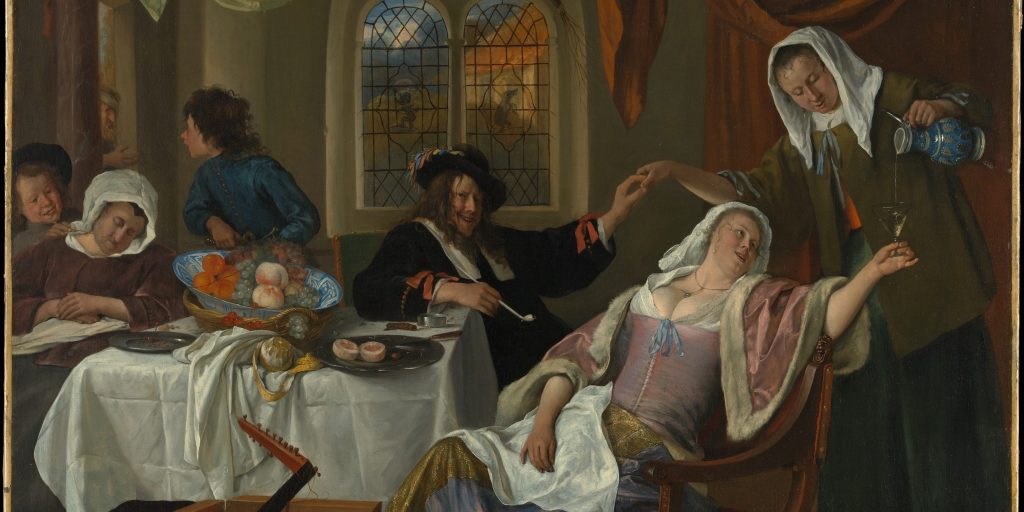
The kingdom of heaven may be compared to a king who gave a wedding banquet for his son. The king is powerful and well-connected; he controls commerce and industry, entertainment, the powers of war, and many are eager to please him or at least profit by being close to him. After the first round of guests fail to materialize, we see that the king’s ego is fragile; he will not be made a fool of, and he sends out his forces to exact punishment. Participation is mandatory. The banquet hall must be filled. And like it or not, soon everyone is swept up into the king’s party. It’s a pretty good party! There’s good food and drink, live music, sparkling conversation. You can fill your belly, mingle and see who’s who, and forget the outside world for a while, where there is enough weeping and gnashing of teeth for this life and the next. Who knows? You could meet someone who has just the right connections to give you a leg up. But soon enough, there is an altercation. The king finds someone who is not dressed to the nines, who is not enjoying the excess on offer, who has been sized up and found lacking, as if they were given a choice about their attendance in the first place. So the king throws them out of the party, if not into hell, then at least into the world as we know it. The other guests simply watch and say nothing, or turn their back to the situation and carry on with their conversation. The kingdom of heaven may be compared to this.
Jesus begins the story with an invitation. Listen to this story, and see what you find in it. Hold it up against what he has taught you about the kingdom of heaven. Who do you see in this story? What does it sound like? Where is God in it? Where are you?
One of the things about the world of scripture is that time and time and time again we are reminded that the faces and names and even the robes of the kings of this world may change, but their proclivities do not. Even Jesus knew what he was doing when he painted a picture of a king who was vengeful, powerful, wealthy, and jealous. There have been an untold number of stories coming to us over the past several days from Gaza or from Washington that show us just how wild the party has gotten: a cavalcade of people jostling for power, influence, revenge, wealth, and so much more, as the expendable, the inconvenient, and the demonized suffer in outer darkness, a living hell. Those who are thrown out are the ones we have decided do not belong, who remind us of inconvenient truths without even having to open their mouths, who show up in the way that Christ so often does. St Matthew himself will remind us of Jesus’ warning in a few weeks, “As you have done to the least of these, so you have done to me.” But the party goes on. “Pour us another round of the blood of the innocent, which is so intoxicating. Pay no attention to the soldiers bothering those people over there; they aren’t even wearing the right clothes.” And even if all the partygoers are not directly participating in the worst of the revelry, there are plenty who are content to stay silently and enjoy the food while it lasts. The kingdom of heaven may be compared to this, but God help us all if the comparison is favorable. It may not seem like it, but we are closer to good news now than we were. At least now the story is starting to tell the truth, about the kings of this world and the party we are all caught up in.
The kingdom of heaven may be compared… to what? Listen to another description of the kingdom: “Like heat shaded by a cloud, the tyrants’ song falls silent. On this mountain,the Lord will prepare for all peoples a rich feast… [with] choice wines well refined. He will swallow up on this mountain the veil that is veiling all peoples, the shroud enshrouding all nations. He will swallow up death forever. The Lord God will wipe tears from every face; he will remove his people’s disgrace from off the whole earth, for the Lord has spoken.” (Isaiah 25)
Listen again: “Blessed are the poor, for theirs is the kingdom of heaven. Blessed are the weak, the hungry, the merciful, the grieving, the persecuted, the peacemongers… for theirs is the kingdom of heaven.” (Matthew 5, Luke 6)
Jesus has hidden another gift inside this story, which is that it is unfinished. Outside the gate there is weeping and gnashing of teeth, to be sure, but in their hurry to get back to the party, most of the people inside missed something. Not far away, huddled around a few candles and a simple feast of bread and wine, is another party, and the guest list is one for the ages: all those too poor, too weak, too merciful for the main event. And every time the king casts someone out into the darkness, someone hurries over and invites them out of the darkness and into this small but brave and marvelous light, where violence and quarreling has been removed from the equation, where tears are wiped away, where Death and all of his friends have no invitation, and the table somehow is always as long as it needs to be, with more room to spare. The good news is that Jesus has told us at great length what the kingdom is like, and he trusts us well enough to be able to tell the difference. The parties of all the kings through all the ages will and must come to an end. But through words, through the example of his beloved, through his very own Body, Jesus has assured us that his party goes on, world without end.
 Noah Stansbury
Leave a comment