The Fourth Sunday of Advent, Year B
Luke 1:26-38, 44-56
All Saints Episcopal Church, Austin
There will be no Christmas in Bethlehem tonight.
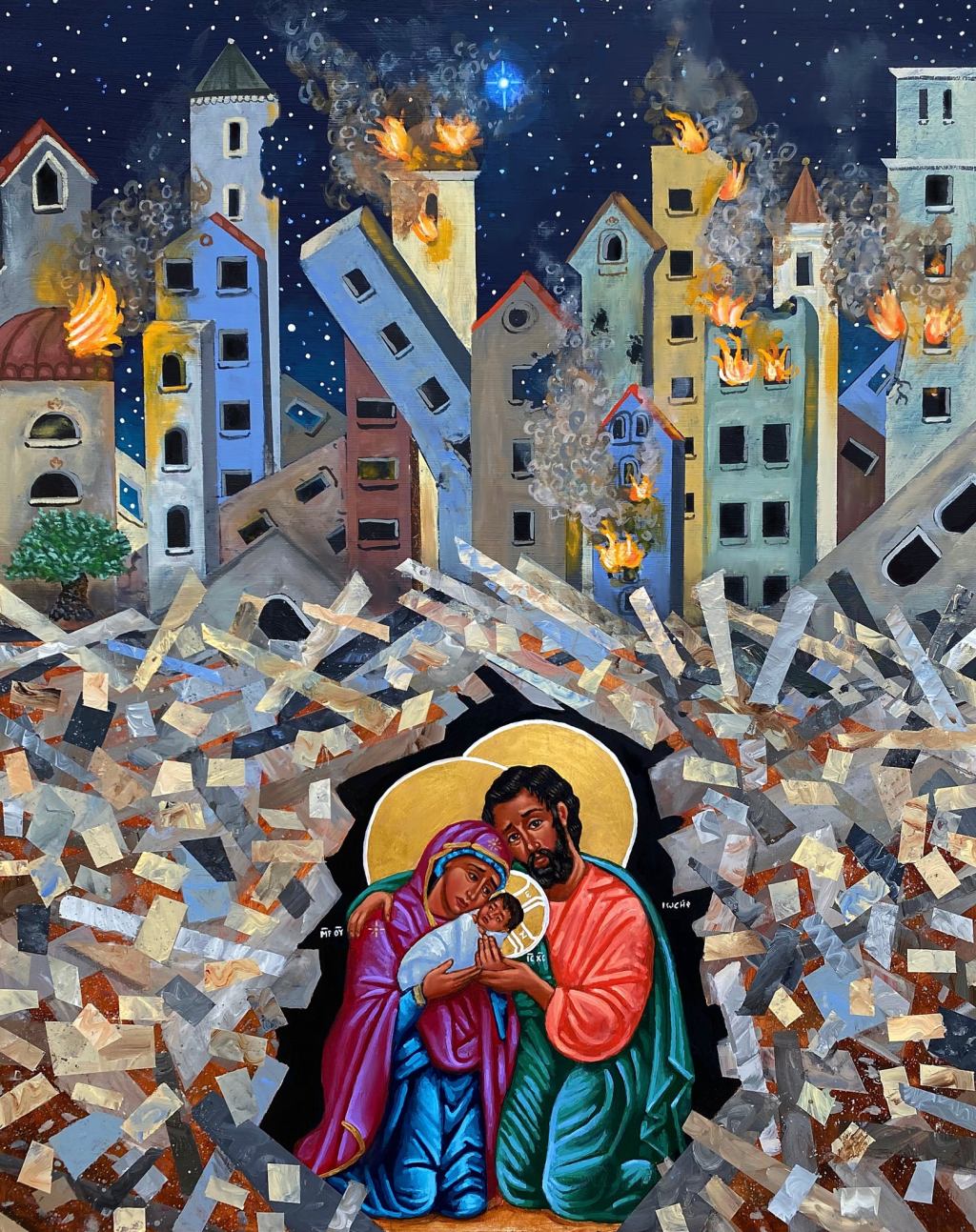
This was the decision made several weeks ago by the leaders of the Christian churches in Israel, Palestine, and Jordan, across the spectrum of denominations: to forego the typical festivities that mark the birth of Jesus. Bethlehem, as you might imagine, normally welcomes thousands of pilgrims this time of year. But this year there are no parades, no Christmas markets, no lights, no tree in Manger Square. Instead, a more somber and restrained observation of the season as the Church in the Holy Land calls the world to mourn the more than 20,000 lives lost in the war in Gaza since October. Bethlehem lies within the West Bank of the Palestinian territories, just south of Jerusalem, and in the face of such devastation and grief, our brothers and sisters there are standing in solidarity with the victims of violence in Gaza. At the Lutheran church in Bethlehem, this year the nativity scene has been replaced with a scene of the infant Jesus swaddled and surrounded by a pile of rubble. Pastor Munther Isaac asked in his sermon yesterday, “We are asking, could this be our fate in Bethlehem?… Is this our destiny too?… In Gaza today, God is under the rubble. And in this Christmas season, as we search for Jesus, he is to be found not on the side of Rome, but our side of the wall.”
It’s a little after 6pm in Bethlehem, and it is, we pray, very quiet right now. There will be no Christmas in Bethlehem tonight.
I don’t spend too much time reading the news these days, truth be told, and I haven’t decided if that’s a personal flaw or an emotional self-defense mechanism. But even so, it is nearly impossible for me to escape the stories and images of what has been happening to the citizens of Gaza in plain sight these past months, they are so ever-present: the indiscriminate bombing of hospitals and houses of worship, the brutal murder of pregnant women seeking refuge, two Palestinian women taking refuge in a church who were killed by snipers, the occupation of Al Ahli Episcopal Hospital and arrest of most the staff. The W.H.O. reports there are no functioning hospitals left in Gaza. In Gaza the Christian population was under 1000 people before the war, with lineages going back centuries, and it is unclear what will happen to them now. These are what Fleming Rutledge would call Advent stories–reminders that “Advent begins in the dark” when we look deep down into the darkness of the human condition and find God’s absence, underscoring the desperation of our predicament and need for divine intervention. The Church’s prayer in Advent is always maranatha! “Come quickly, Lord Jesus!”
It is not the first time the land of the Holy One has found itself in such a state. The Gospels all open onto just such a scene of terror, with the brutality of an occupying army and the possibility of bloodshed around every corner. Indeed Jesus will barely have been born before the rulers of the kingdom begin calling for the execution of children and Mary and her baby flee for their lives; most churches skip that part of Matthew’s gospel. No matter how we try, these stories of the birth of Jesus are not warm and cuddly, never as pious and sanitized as we make them. They are visceral and dangerous, a happy outcome not at all guaranteed… and that is why the story of the salvation of the world begins there. It is precisely these places of profound vulnerability that we are able to perceive that God is at work. It is not just any moment that God chooses to break into the world and into the life of a young woman from Nazareth to make an impossible request. God did not wait for Mary’s engagement to Joseph to be happily resolved, or for an era of safety and prosperity when Mary’s people controlled their own destiny. God is seldom in the habit of appearing to those who have already won victory, who enjoy many of life’s comforts – or perhaps God might, but it is harder to hear the messengers. It is precisely when we are at our lowest point, when the last threads of hope begin to unravel, that God shows up, when one of God’s messengers appears and says, “Be not afraid. The Lord is with you.”
God draws nearer to Mary than to any other person before or since, and her response to this action is quite simple, and astonishingly clear. After her consent–“Be it unto me according to your word”–she immediately sets out to meet her cousin Elizabeth, who is also improbably pregnant, and together they rejoice in what has happened and what it means. We sang Mary’s song a few moments ago: “Tell out my soul the greatness of the Lord! Unnumbered blessings give my spirit voice.” But in her own words: “My soul proclaims the greatness of the Lord, my spirit rejoices in you, O God my Savior…. You have shown strength with your arm, and scattered the proud in their conceit, casting down the mighty from their thrones, and lifting up the lowly. You have filled the hungry with good things, and sent the rich away empty.”
For centuries this song that comes on the heels of the incarnation has been the key to how Christians understand God’s vision for the world. The one Mary holds in her womb–the most high God, the eternal Word who spoke and the stars sang for joy, whose spirit hovers over the earth and breathes all things into being–this Lord of all Lords is being knit together in her womb. God’s decision to enter the world in this way through this person, lowliness begot of lowliness, changes everything. The Mother of our Lord, the first person to say yes to Jesus, knows him best of all, and her song reechoes down the ages to remind us that God’s intent is to topple every earthly power, to snap every weapon, to humble every cruel heart, and to come to the rescue of the downtrodden, the grieving, and the hungry. Our Lady joins the psalmist in his invitation: “Come now and look upon the works of the LORD, what awesome things he has done on earth. It is he who makes war to cease in all the world; he breaks the bow, and shatters the spear, and burns the shields with fire” (Psalm 46). God comes into the world and calls for war to cease. God calls for a ceasefire: unconditional, total, now, and forever. A vision of the world that does not look like Mary’s song is not the work of God, and it is not the work of Jesus.
God has told us whose side God is on, in no uncertain terms; and it is through the Mother of our Lord that God has shown us who is worthy to bring him into the world that we might see him more clearly: the meek, the unpowerful, the unbelievable, the underdogs. “Consider your own call, brothers and sisters,” St. Paul reminds us. “Not many of you were wise by human standards, not many were powerful, not many were of noble birth. But God chose what is foolish in the world to shame the wise; God chose what is weak in the world to shame the strong; God chose what is low and despised in the world, things that are not, to abolish things that are, so that no one might boast in the presence of God” (1 Corinthians 1).
There will be no Christmas in Bethlehem tonight, but the good news is that God’s plan of salvation is not confounded. The incarnation, the enfleshment of our God, continues in every generation. Mary makes her way to Bethlehem even now, and Christ will be born among the rubble, as he always has been. These are the moments, the places, the people into which Christ is born.
Will we look for him there?
Will we call for his protection?
Will we receive the message of his mother?
 Noah Stansbury
Leave a comment