The Fourteenth Sunday after Pentecost (Proper 16B)
John 6:56–69
All Saints’ Episcopal Church, Austin, Tex.
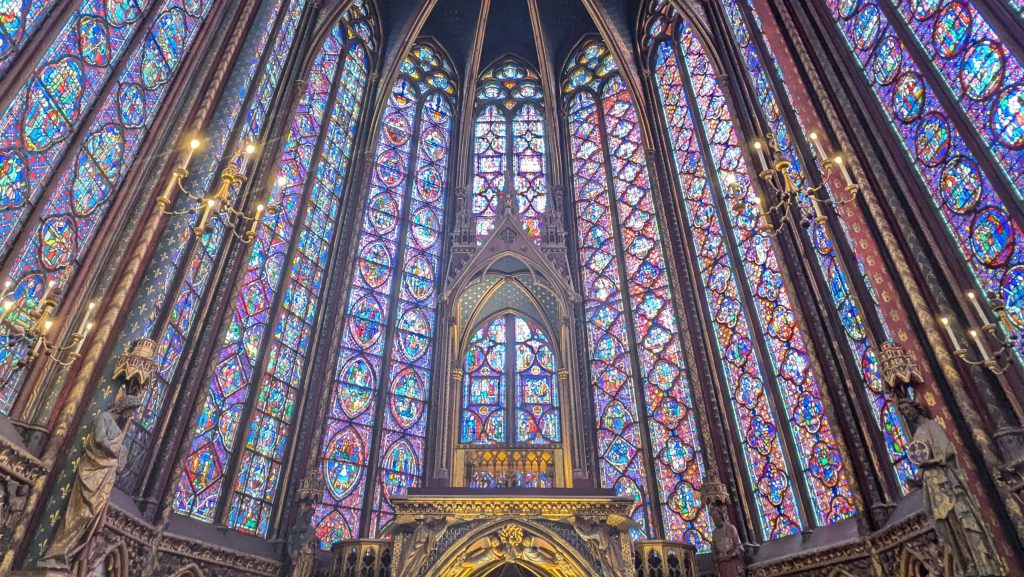
A few weeks ago I had the opportunity to travel to Paris with a friend. I had visited Paris once many years ago but one landmark that had somehow escaped my notice was Sainte-Chappelle, one of the great chapels of the kings of France (back when France went in for things like kings). Sainte-Chapelle has stood for nearly 800 years on the same island as Notre-Dame at the heart of the city, and is known for its windows of stained glass, much of it original to the 13th century. I had seen pictures, of course, but as we climbed the narrow stone staircase and emerged into the room, I recognized they had not done it justice. Thousands of panes of glass weaving together hundreds of scenes with exacting intention rising nearly 150 feet in the air – pane after pane after pane, seemingly unbroken by masonry, a riot of light and color, impossible to take in all at once. It should not have come as a surprise to me that of course the windows were meant to be read. We entered the room under the Genesis window, dozens of scenes beginning with the creation of the world that proceeded in order from bottom to the far-off top, then the next window picking up with stories of the Exodus and wandering in the wilderness, on through the stories of Israel’s kings and prophets, culminating over the altar with the Gospels – stories from the life of Jesus and the events of Holy Week, and an entire bay dedicated to the story of the chapel itself, built to house, it is said, the crown of thorns itself. Louis IX, the pious king who is remembered as a saint today, August 25, was moved to give physical manifestation to the stories of his faith, because he thought they were worth telling and because he understood himself to be in the midst of something much larger than him and he did not want to forget. And here they stood, right in front of me, to continue that work. A friend called it “the most beautiful room in the world” and I cannot say he was wrong.
As we did our best to take this all in, we were of course joined by dozens of our new best friends, the other tourists who were with us. People from all over the world wandered around, speaking to each other in hushed tones and pointing to what they saw far over head. From time to time the excited whispers would rise to a crescendo and punctuate with a voice that rose over them: “Silence s’il vous plait ! Merci.” “Quiet, please! Thank you.” Things would quiet down for a bit, but this happened a few times. After the second or third “silence, sil vous plait”, as I was trying to make out an obscure scene from the book of Kings (or was it the Gospel of Mark?), something broke through into my awareness. The windows were still speaking, and in some mystical way, here we were to give them voice and carry them on. Like Louis, whether we meant to or not, we had found ourselves in the middle of something still in the process of being told, and there on that day had taken our place in it, however small.
I was overcome with the sense, not for the first time, that we are fundamentally story-telling creatures. We can’t help it. If you want to get to know someone, they’ll start telling you part of their story. My name is Noah, I was raised by people whose stories in turn came from a small town in Virginia, which means they believed in the duty to set yourself aside for the good of God and country, and I have been trying to figure out how to do that ever since. We follow a God who has revealed themself in and through and as Story, as Word-made-flesh, who feeds and sustains us with the essence of who he is, as ordinary and miraculous as a bit of bread. We gather here every Sunday to read from a few of those stories that have been passed onto us and to find where they resonate with our own. Christianity is not a set of doctrines or beliefs or a checklist of actions, it is a story that shapes the way we see ourselves and the world. If you want to know God you have to know God’s story, because that is one of the primary ways God tries to talk to us.
We are all shaped by stories, both the ones that have been told to us about the world and the ones that we in turn tell ourselves about what is real and what is possible. The American theologian Stanley Hauerwas has written at some length about the importance of the stories that shape who we are as individuals and as a society, and particularly whether those stories are true. Not true in the sense of stories that are made up of only the very best facts or the stories we have been told are the right ones to believe, but stories that allow us to see the world as it is, face into it with courage, and go on. “When we do not understand, we are afraid,” he says, “and we tell ourselves stories that protect ourselves from the unknown and foreign.” A true story is one that confronts us with reality and encourages us to live into that truth, to journey through the unknown and foreign, whether it is what is right in front of us or something deeper that may have been obscured. A true story, in other words, is a story that comes straight from the Spirit of life itself, who fills all things and feeds us, strengthens us, nourishes us toward an understanding of ourselves and the world that finds joy and hope in the midst of suffering. At their best, universities are places where true stories are sought out, the primary goal for student and teacher and administrator alike. As we begin a new year, we do well to pay attention to the stories we are telling ourselves about what universities are for and what we are doing here, especially where money, power, and keeping up appearances stand ready at every moment to lead us astray from true stories people need to hear.
We are, all of us, part of a story, and we need to be sure the stories we tell are true. Saint Louis IX understood this and built a monument to it, to remind himself. Peter understood it when he asked, baffled, “Lord, to whom shall we go? You have the words of eternal life.” What are the stories that we let direct us? What stories have been told to us? What stories do we pass along to others? Do they bring life? So many lives end in tragedy because they are crippled by stories that are false, not least because people conclude there is no hope for them, and often no hope for anyone else. But here we gather to place ourselves in a Story that began long before us and will continue long after us, a story that is about many things: the redemption of our many failings not least among them, but also beauty, hope, justice, and love. It is a story that invites us to set aside our ambition and simply take our part within it. This teaching is difficult. Telling ourselves a story of forgiveness, justice, and love is simple, but letting ourselves be changed by it is harder. But if all that sounds too lofty then we gather here at the very least around a story about being fed, nourished, and nurtured by the Word-made-flesh, whose nourishment does not end and whose story is nothing less than true, and hope-filled, and life-giving. Take and eat, this is the bread of heaven that keeps you in everlasting life.

 Noah Stansbury
Leave a comment