Holy Cross Day
1 Corinthians 1:18-27
John 12:31-36a
Texas Canterbury, Austin, Tex.
Therefore he who shows us God
Helpless hangs upon the tree;
And the nails and crown of thorns
Tell of what God’s love must be.
Here is God, no monarch he,
Throned in easy state to reign;
Here is God, whose arms of love,
Aching, spent, the world sustain.
–W. H. Vanstone
I.
There’s a lot of violence in the news lately. I don’t just mean this week, though there is certainly plenty. Over the past couple of years, it seems that at least our awareness of the violence in the world seems to be intensifying and escalating.
The news this past week of the murder of Charlie Kirk and the reactions to it are, of course, upsetting and alarming, but it is not the first step along the way. There have been other political assassinations, just this year, on both sides of the political divide. There is an incredible amount of rhetoric in the news and online, calling for the abuse and deaths of immigrants and homeless people. The ongoing conflict in Ukraine and ethnic cleansing in Palestine continues to worry people of all persuasions.
This uptick in the normalization of violence in our society involves all of us. It impacts all of us. It isn’t about one particular week in the news. It points us to a deep illness that is playing out in every part of our political discourse: the conclusion that the only way to solve a problem is to find a person or group to eliminate. There are more and more people in the world, including Christians, who have put their trust in the power of violence, destruction, and death.
I find myself thinking about past moments when humanity has found itself in particularly intense periods of violence. The Civil Rights movement of the 1960s in the U.S. comes to mind: another period marked by high-profile assassinations. Before that, the Second World War, the Holocaust, and the events that led up to it in Germany, and especially the role that Christians played on both sides of that question.
These moments, like the one we are living through, confront us with deep questions with deep consequences; questions about the kind of world that we want to live in, about what is a good society. For Christians, they also ask a set of questions about how we look to what God has promised to his children, and discern what we are called to do or not do.
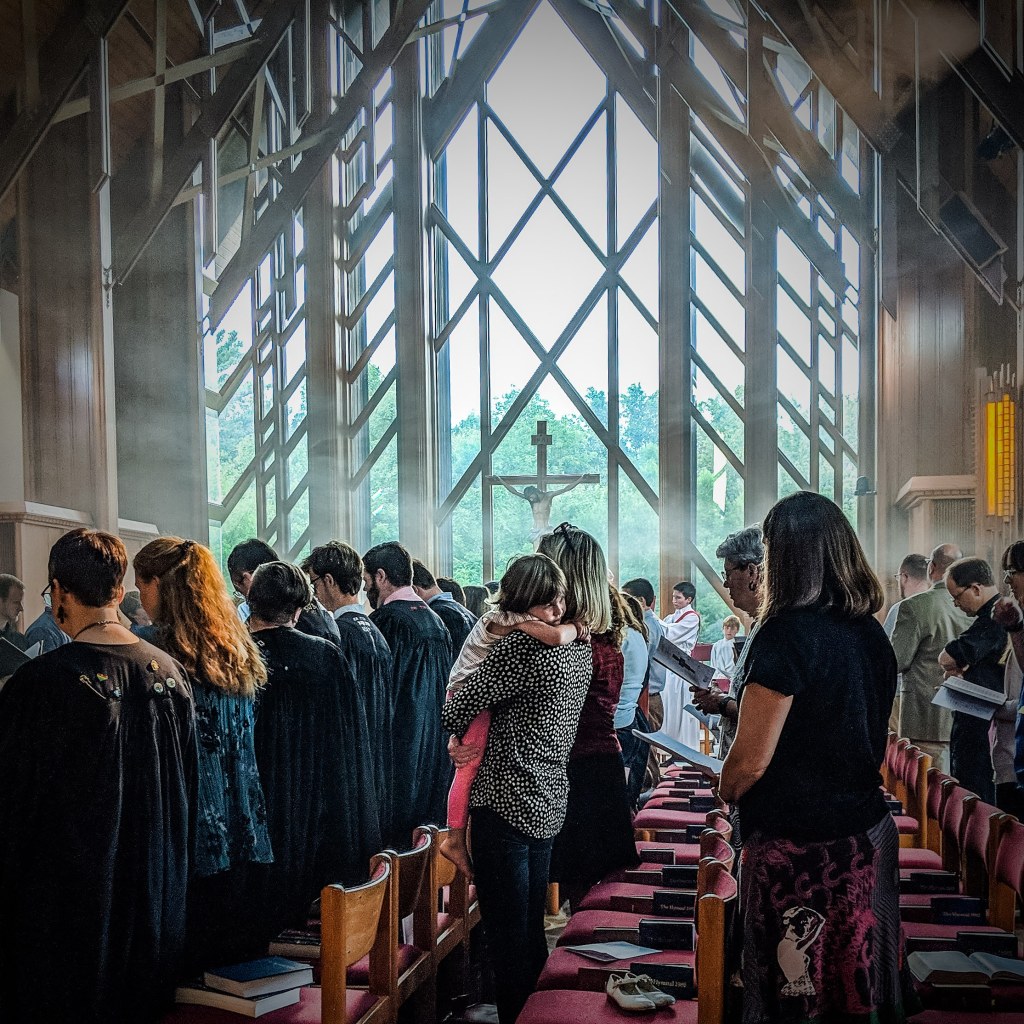
We gather today on the Feast of the Holy Cross. Of course, in every church you’ve ever been in, there is a cross. The one we have here behind the altar happens to be empty, but many have depictions of the crucified Christ on them. This is the central image of our faith: the shorthand by which most of the world knows the followers of Jesus.
When we find ourselves in periods of particularly intense violence and conflict, it would be a mistake for us to ignore that reality and say that violence has nothing to do with our faith. Not only would this be a mistake, it would be a lie. Our faith, symbolized by that cross, has many things to say to moments like these, and to people who are caught up in the cycles of violence that humanity has known so well in every time and place.
II.
Today’s reading from the Gospel of John comes right at the turning point in that book. Jesus is about to finish his public ministry of teaching, healing, and feeding. From this point onward, the story is very much concerned with the work he knows he is called to accomplish at Jerusalem: the events that will lead to his death, and which we now remember on Good Friday and Easter.
Jesus understands and is dedicated to the course of events that will put him on this path. In this passage, he knows that his time has come to spring into action: “Now the time has come for this world’s ruler to be cast out, and when I am lifted up”—that is, crucified—“I will draw all the world unto myself.”
The crowds he is talking to are confused by this. He has said things that make it clear that he believes he is the Christ, or the Messiah, the anointed one that God has sent to Israel. So they reply: “Well, you’re supposed to be here forever. If you really are who you think you are, what do you mean?”
This is an important theme in John’s gospel: who does Jesus think he is? From the beginning of his book, John has been intentional about the ways that he portrays Jesus and the words that he has Jesus say. But when he opens the book he doesn’t just go back to the birth of Jesus, or Jesus’ family history, in the ways Matthew and Luke do. He goes back all the way to the beginning, to Genesis chapter 1. In the beginning, God created. This is the first thing the Scriptures want us to know about God: that God is a creator, and that what God creates, God calls good. John puts it a little differently, though. Even if you are familiar with how he starts out, I’m going to read it for us all to consider:
In the beginning was the Word
and the Word was with God
and the Word was God.
The Word was with God in the beginning.
Everything came into being through the Word,
and without the Word
nothing came into being.
What came into being
through the Word was life,
and the life was the light for all people.
The light shines in the darkness,
and the darkness doesn’t extinguish the light.
When Jesus comes into the world, he teaches us a lot of things. Many people love to engage with Jesus as a great teacher. But John calls Jesus the Word with a capital W; in other words, the very essence or rationality of the eternal Creator. This Word brings everything into existence, and everything that comes into existence is full of life.
This is the litmus test by which we judge whether something is from God, because it is the only thing Jesus knows how to do. If Jesus is the Word with a capital W in human flesh, walking around like you or me, then that becomes the light in which we evaluate all other things.
What does this imply for all the other stories we tell about God and about ourselves? It is the light that is cast back even on the rest of scripture as we turn over this question: what does God have to say about violence?
III.
Jesus understands the values and the teachings by which he has oriented himself: life, love, healing, justice. These are the things by which he calls us to orient our lives as his followers. He understands that his commitment to this way of life is going to put him in conflict with people in power, and that his radical commitment to peace is going to get him killed.
By willingly going to the Cross, Jesus intentionally, proactively, knowingly orients himself on the side of the victims of violence—not in spite of who he is, but because of who he is. He sees the fears which we are tempted to put our trust in, and the blood that those fears have spilled throughout history. He sees the helplessness under which humanity labors in these cycles of violence we know so well.
Jesus, fully God and fully human, sees our predicament and he says: “I will not play this game. I will not use my power to commit violence, even to save myself.” That is the God we follow. That is what God has to say about who God is. The only thing that can come into being through God is life. The God who is revealed to us on the cross does not, and cannot, counsel violence.
Death is a powerful force in the world. Its only goal is to undo the good creation that God has given to us. It loves find ways to decreate us, to uncreate us. Death uses the temptation to violence and abuse against other people as its most powerful tool.
We follow a different path, a different God who has overcome death by subjecting himself to it, and this is the foolishness that Paul speaks of in our reading from 1 Corinthians. Faithful Christians, who follow Jesus to his logical conclusion, trust that violence ultimately has no real power. It is a tool for fools who don’t know any better. Death always consumes those who use it. But we proclaim Christ crucified, and lift up his cross as a reminder that we trust someone with more powerful tools to build the kind of world we hope to live in. It confounds us all. It makes no sense. It is a provocation for both those who have been part of God’s story for a long time and those who are new.
IV.
John starts with Jesus’s role in creation at the dawn of time because he sees that work of creation as beginning anew in Jesus. In the beginning God created, and the new way of life that Jesus shows us on the cross is another beginning, of something new that is still working itself out.
Throughout his earthly life, Jesus sees himself as part of that work. And having risen from the dead—having not been overcome by that death, not overcome by violence, not overcome by destruction, because he is life itself—he then gives that life to us.
It is a new way of life, to walk in that light that Jesus continues to push forward into every darkened corner of the earth and to every darkened corner of every human heart. He hopes for us when we cannot hope for ourselves. He encourages us, calls us, beckons us to walk in that light. Not perfectly. Not because we earned it. But because we trust that it is a light that will not fail. This is not a light that simply exposes and embarrasses, but a light that enfolds and embraces, that gives warmth and love. It casts out fear, as love must. Fear is the source of all violence, of all temptation to destruction and despair, but it cannot withstand the love that lies at the heart of God, displayed on that Holy Cross.
Some of you know I love to give away books, and that I have an entire wall of them in my office. As we walk through this time of conflict, we will need to heed the wisdom of our forebears. We are not the first to be here. We are not alone. We need their wisdom, and for these many hundreds of years, that wisdom starts with the Cross.
We have been given a new way to be human. We are as good as dead to the urges of the world, to all its fears and desperations. We have been given a light to walk in, a light to hold, a light to shelter, and a light to spread to others. May it be so.
 Noah Stansbury
Leave a comment