You can watch this sermon above at 26:30.
Advent 3A
Isaiah 35
Matthew 11:2-11
All Saints’ Episcopal Church, Austin, Tex.
Over the millenia, a consistent topic of inquiry in human thought has been the wilderness. What is it and what does that have to say about who we are? Is it a place of danger or a place of awe and beauty, or something else? Are we part of it, or are we meant to master it? Many of the first chapters of the Book of Genesis offer some possible answers to this question, beginning with the fact that God places the first humans not in a bustling city, but in a garden. We do not stay there long, of course, as our first ancestors are quickly driven out of the garden into a place of desolation and danger, a place that will demand much of them if it is going to be survived. They quickly learn that death of one kind or another seems to be the cost of doing business, beginning with the animals whose skins they are wearing. But the wilderness demands interdependence as well; we all live or die together. We will all need one another in order to make it.
The high-level question of settlement versus wilderness, community versus chaos, can arguably be seen as one of the primary lenses through which one reads the scriptures. A few chapters later we are confronted with a stark lesson when the peoples of the earth gather to “make a name for themselves” (as the author puts it) and embark on history’s first civil engineering project: the Tower of Babel. This too ends unhappily for those involved. The promise of connection and an effort to build a monument to human power ends with the people separated and unable to understand one another. From this point forward, the authors of scripture seem to be generally skeptical of what happens when humans live too closely together.
Famously, of course, the Hebrew people are eventually enslaved and forced to build cities as monuments to Egyptian progress. After they are liberated from their enslavers by the God of their ancestors, they are led out into… the wilderness. Where else? There is nowhere else to go. As they journey towards the land of promise, they are transformed slowly from a people who only know what to do when someone tells them to do it, to a people who are able to exercise some kind of agency within the liberation that God gives them. Throughout scripture, the wilderness is not only a place of danger or deprivation, but the place where God forms a people capable of genuine community and all that comes with it. What follows when the Hebrews arrive in the promised land can, in some way, be seen as a critique of the ways that they go back to where they started, falling back into old habits. Before long, they are yearning for protection back in the city, this time Jerusalem, justifying their need for a king and a temple when God more or less explicitly advises that these are not good ideas.
Cities are seen throughout scripture often as dangerous accelerants of the human tendency to exploit others for personal gain, where political and economic power is consolidated and then wielded. Cities are seen as places where the prosperous use what they have gained from others, probably unfairly, to live in ways that the common people are unaccustomed to. Many of the most prominent voices in scripture are people who are at the mercy of those in the halls of power, and when we hear stories of those who make the transition from the underside of society to wearing soft robes in royal palaces, they are frequently showcased as examples of What Not to Do.
By the time that we arrive at the life of Jesus it is no great wonder that one of the first characters we meet in the Gospels—Jesus’s cousin John—has done something unexpected and perhaps foolish in the eyes of those around him. He has abandoned the pleasures and protection of the city and gone out into the wilderness. John appears in the wilderness preparing the way for a savior who is perhaps not quite well understood yet, even by him. After Jesus’s fateful encounter with John when he is baptized, Jesus himself stays in the wilderness for forty days as he undergoes his own transformation and preparation for the work ahead of him.
There is plenty that could be said about what kinds of cities and systems of power we live under today, which are self-evidently not providing anything like true community for the vast majority of people. Eight out of ten Americans live in urban and suburban areas; up from about 50% a hundred years ago and 7% a hundred years before that. We have undergone a radical transformation in a relatively short period of time. It is a great sorrow and no small irony that we are more disconnected and alienated than ever. Many of the realities that we live with expect and often demand that we regard our neighbors with suspicion, if not outright disdain. It is taken for granted that I do not really need to know the names of any of the neighbors in my apartment building, let alone have an actual relationship with them. Comforts and conveniences that we are accustomed to come at the cost of the well being of others, and this is treated as if it is no great concern. All of this is simply the way things are, because we have been told that this is the way things are, and questioning it frequently comes at no small expense.
The great gift of interconnectedness that the World Wide Web first offered us has curdled into a place where people of all ages, but especially our younger generations, are funneled into silos, increasingly detached from any hope of a shared reality and story with the people around us. To spend any substantial amount of time on social media (speaking from my own experience) is to be faced with the grim truth that interacting with an actual human being is no longer guaranteed or even the point. Like Babel, our systems promise connection but deliver fragmentation. Like the cities of Egypt, they demand endless productivity and celebrate progress while ignoring the very real human cost. The forms have changed, but the logic has not. We are pushed into wildernesses that merely isolate and kill, without the opportunity for transformation that the scriptural image of the wilderness often carries with it.
Every Advent, we are invited into the wilderness by and with John, but not for the sake of isolation and despair. John calls us to prepare the way in our own hearts for the coming of the promised Savior, even if we do not exactly understand who he is yet. The way we are living will not achieve this on its own, and in fact may work against it. In the scriptural imagination, the wilderness is a place where our illusions are stripped away and we come to ourselves and to one another. It is the place where vulnerability becomes unavoidable, where the urge to control works against our best interest, and where the truth can no longer be ignored. The repentance that invites us to prepare the way for the new reality that is coming does come at a cost. But it is nothing less than our own willing realization that the status quo is no longer sustainable for us as individuals or as a society or for God’s good creation, wild and beautiful. We can’t keep living like this. John makes no promise that giving up what keeps us complacent or fearful will not cost us or be uncomfortable. He offers us no guarantee that the wilderness is any less dangerous than it has ever been.
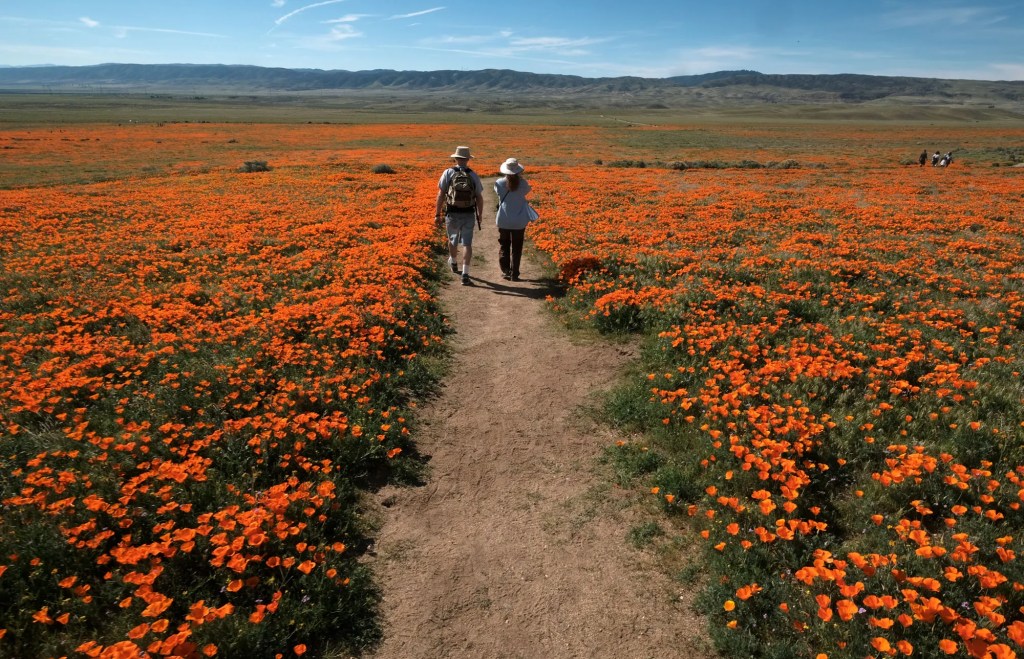
The realization itself is not enough to prompt us to turn off the TV, put down the phone, and walk out into the great unknown. There is still the very real problem of our own fear to contend with. It is to this reality that the prophet Isaiah speaks when he offers us a vision of the wilderness that is not all desolation and despair and discomfort, but rather that the wilderness is the cradle of life itself. “Be strong, do not fear!” Isaiah offers us a vision of the wilderness that is plenteous, even beautiful. Jesus goes out ahead of us and wherever he steps the thirsty sandy ground bursts into bloom carpeted with roses, a new Eden ours for the enjoying. We can walk out into the wilderness on our own like John or be pushed into it by circumstance like the Hebrews. However we get there, leaving behind the familiar and the comfortable is where God starts working. It is where the slow and insistent work of restoring us to that original state of joyful union with God and one another can begin. The wilderness is a place where there is finally room for God to work.
It is in the wilderness that we find ourselves transformed, ready to receive the gifts that trail in Jesus’s wake: sight that understands the present, freedom to walk confidently into the future, wellness and vitality that opens our selves to others, a listening ear for the movement of the Spirit: all of this life and that abundant. In the end, even our cities, our faltering attempts to be with one another, are renewed. The final image of scripture in the Book of Revelation is a great heavenly city coming down to join ours, a place where all of humanity and God are gathered together in peace and joy, world without end.
In this moment, in this Advent season we are invited into the wildernesses of our lives. We are invited into careful discernment about what our values and assumptions bring into bloom. Are they the roses of Christ or are they the thistles of something else? We are invited to consider what the way we are living brings into being. Wilderness may look like choosing to be present to others even when it’s hard, choosing the dignity of others rather than convenience, choosing trust rather than the need for control—small decisions with real costs, where there is room for God to work. What can at least be said about the people of God, beginning in Eden and on down to our own day, is that we are called to be a people of interdependence: people who are radically committed to knowing one another, a genuine community outside the protection and falsehoods of the city. The Church is where this begins. The Church is where we are knitted into that Body of Christ which then goes out into the wilderness after him, following the path that he has already laid for us, ready to share what we have heard and seen: for our God has come to save us.

 Noah Stansbury
Leave a comment