Ash Wednesday
Isaiah 58:1-12
2 Corinthians 5:20b-6:10
All Saints’, Austin
Many years ago a national emergency brought a certain country to its knees. Pressures from within society and from foreign powers drove national anxiety through the roof. Polarization and division taught the people to distrust one another. Ancient fault lines in the nation’s identity were exposed. Unjust rulers exploited those divisions for their own gain, gathering power and wealth to themselves, committing atrocities against their own people, and plunging the nation into wars. In the end all came tumbling down; the government collapsed and left the nation a ruined husk of itself, with the people wondering what came next and what to make of what was left behind. You may be able to guess that this could describe any number of times and places. It’s an old story. Today I want us to consider three such cases.
I.
The year was 500 BCE and the nation was the tribes of Judah, returning to their homeland after the failure of their kings led to generations of captivity in another country. They stand among ancient ruins, foundations of a life that no longer exists, struggling to rebuild. It was never going to be easy, but things are not going well for them. When I hear Isaiah chastising the people for their hypocrisy it is easy to imagine that the group he is addressing must have been a smug, self-aware bunch. We’ve met these people, right? For years I have heard a note of sarcasm in the questions the people ask in this passage, “Why do we fast, but God does not see? Why humble ourselves, but God does not notice?” But a more careful reading of the passage shows no such double-dealing on their part. The way Isaiah puts it seems to show that there is genuine confusion. It’s his book, he can put it whatever way he wants; so this more sympathetic or at least neutral framing must be significant. This is a group of people who are trying to encounter God, after all, whatever their motivations may be. The prophet describes them as people who seek God “day after day” and “delight” in doing so. How many people do we know who delight in seeking God? I could describe my spiritual life in a lot of ways, but “delight” isn’t a word that rises to the top of the list for me. The people want to know God, to feel God’s love and protection in a dangerous time. But the prophet notes a problem. It may seem obvious to us but it was not obvious to them. They were putting their religion into practice, following the customs of their ancestors in the places where their ancestors worshiped, and they are leaving their worship unchanged, unconverted, unconvinced. They have not encountered the God they delight in, and they know it, even if they don’t understand why.
Isaiah’s diagnosis and prescription is clear: change your hearts and lives. God is not saving you individually in response to what you do or don’t do and how well you do or don’t do it. God is saving a people, an entire nation. Show your care for others not with words but in action, and let God’s healing be displayed in the sight of all like a light shining in the darkest night.
II.
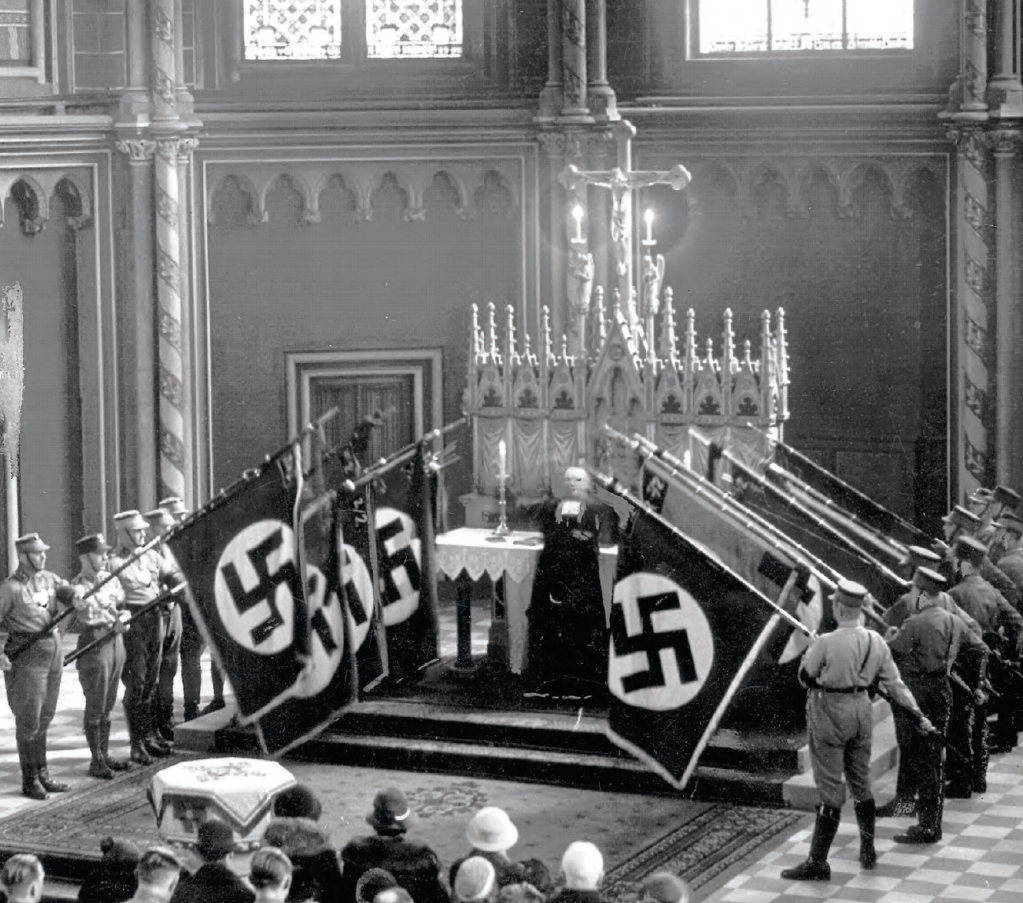
The year was 1945 and the nation was Germany, fresh off the devastation of the second World War and the violent end of over a decade of rule by the government of Adolf Hitler. In the aftermath of the war, in the rubble of Germany’s cities, it was the Church that looked to its past to understand how they had gotten here before they could begin rebuilding. In the 1930s the large majority of Germans identified as Protestant Christians, and in the early years of Hitler’s rule there was a concerted effort to reform the German churches from within, using their influence as a way to promote racist and totalitarian ideology by blending it with traditional Christian teaching. In its final form, this so-called “German Christianity” sought to strip any indication of Jewishness out of the story of Jesus and declare “a new revelation” with a racially purified German nation as God’s chosen people. This was not a sideshow. It was accomplished with the happy compliance of many German pastors; some of the most chilling images I’ve ever seen are of the churches that proudly displayed the Nazi flag in their sanctuaries. In 1934 another group of church leaders who saw the danger for what it was formed a group called the Confessing Church, which insisted on orthodox Christian teaching and resisted this reform movement openly. They paid for it with political persecution, imprisonment, and martyrdom.
Six months after the fall of Hitler and again two years later, German church leaders issued statements confessing their sins that had opened the path for such evil to thrive. “We accuse ourselves for not witnessing more courageously… and for not loving more ardently.” “We went astray, as we felt compelled to form a front of good vs. evil, of light vs. darkness, that falsely created… a polarization of the righteous vs. the unrighteous in political life…. We adulterated the free gift of God’s grace to all and abandoned the world to its own self-destruction….” (see The Stuttgart Declaration and The Darmstadt Declaration)
It’s estimated that only about 10% of the German population were ever actively working towards the goals of the Nazi agenda. Another 10% were actively working against it. Most were in the middle, quietly supporting or quietly trying to lay low. These statements of confession from the German church were being made by those who had been in the government’s crosshairs—and they took responsibility for their own contributions to the catastrophe anyway. They named a national sin on behalf of their neighbors who were not ready to do so, and repented on their behalf anyway, as a sign that the gift of God’s forgiveness and reconciliation is available anew in every time in the face of every atrocity.
III.
The year was 2026 and the nation was our own.
You don’t need me to rehearse the events of the past several years or even the past several weeks. But we can take our cues from the times we have been here before. Lately I’ve been reading For Such a Time as This: An Emergency Devotional by Dr Hanna Reichel. Dr Reichel is a German scholar of Christianity in the Nazi era who teaches at Princeton Seminary in New Jersey, and this past fall they published this short collection of reflections on how to respond faithfully in times of authoritarianism. They encourage us to follow the example of the German churches’ confessions of sin in 1945 and 1947. They encourage us to own what we have done and left undone and to do it sooner rather than later. They write, “A reckoning is necessary, not to lacerate ourselves while evil triumphs, but to understand and disavow what fuels its rise. Repentance is required, not to add insult to injury, but to reclaim agency by taking responsibility.”
This is one of the things we gather here to do today, among the many sins and shortcomings available for us to confess. Perhaps you find yourself confessing the same things from one year to the next. Perhaps you aren’t entirely sure what you’re here to confess but trust the liturgy to do the work. Every year we walk this way into the season of Lent and every year it bears repeating that Ash Wednesday is not the grand kickoff of a 40-day self-improvement challenge, or a day of fasting for its own sake as if checking the box will get God to pay attention to us. Ash Wednesday is about taking responsibility for our share of what went wrong—and yes, even interceding to God and repenting on behalf of our neighbors—so God can draw near to us and empower us for the hard work of choosing to do something else, long after day 40 has come and gone. “The sacrifice of God is a troubled spirit; a broken and contrite heart, O God, you will not despise” (Psalm 51). Dr Reichel draws on the work of the historian Hannah Arendt to reflect that the rise of generational evil is greatly aided by “ordinary people [who] neglect to reflect and fail to resist actively…. For God’s sake, don’t be a bystander.”
In his letter to the Corinthians, St Paul exhorts us not to receive the grace of God in vain. We who have been filled with the spirit of Jesus will, by definition, run up against other powers in the world that seek only to belittle, steal, and kill. Paul’s sufferings which he recounts for us today are a result of his refusal to go along to get along, his insistence on the dignity of others, his declaration that Jesus’s kingdom subverts the claims of the powers that be. Paul never tells the Corinthians or us to go get martyred, but the message here is clear too: following Jesus has a cost. It will be up to you to figure out what that is with the help of mentors and trustworthy guides, but start however you can, however small you can.
Whatever else may be going on in the world, Christians never move beyond our own need to hear the gospel: now is the acceptable time, today is the day of salvation. We have been called to display the death and new life of Jesus Christ to the world, in the words of the old prayer, “not only with our lips but in our lives, giving up our selves to God’s service.”
Hear once more the words of the Confessing Church: “Do not allow doubt to become your Lord, for Christ is the Lord. Bid farewell to every kind of faithless apathy. Do not permit yourselves to be misled by dreams of a shining past or by speculations about an impending war. Rather, in deep sobriety, be conscious of our liberation and of the responsibility that every one of us carries in the restoration of… [our] public life, that will serve human rights, social welfare, internal peace, and the reconciliation of the nations.”
 Noah Stansbury
Leave a comment