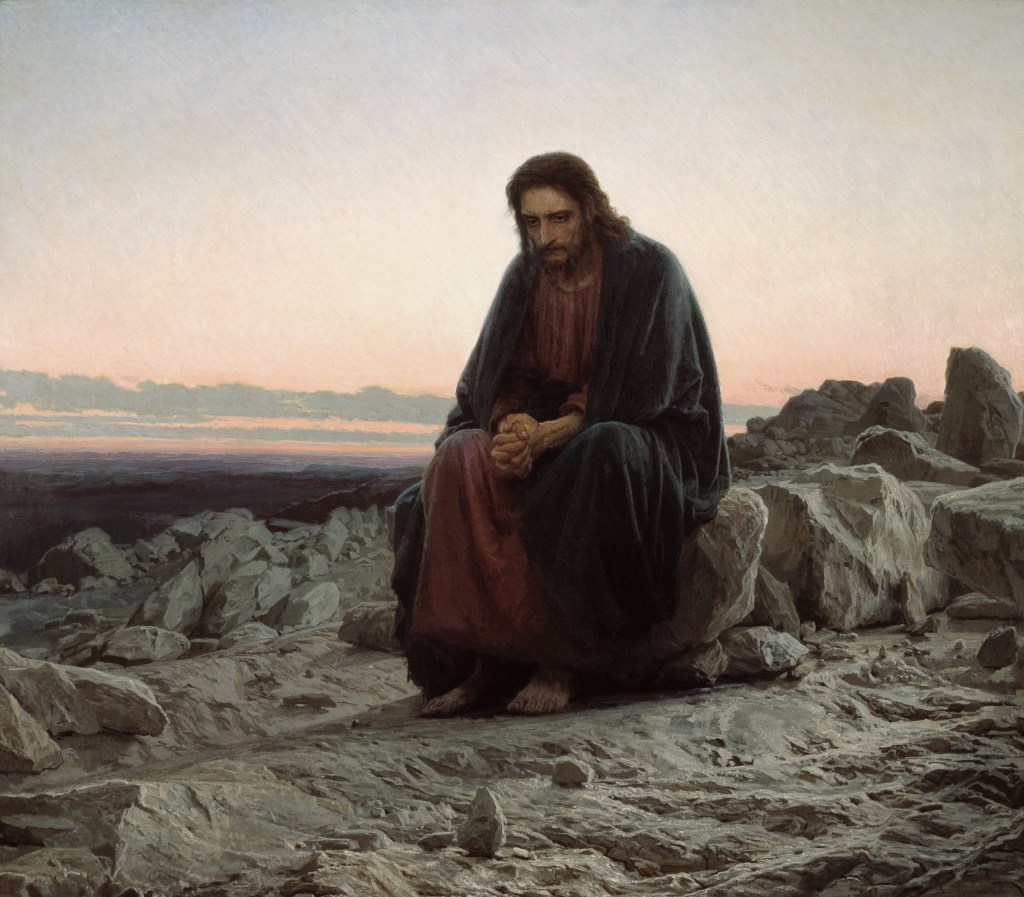
You can watch this sermon above at 31:30. | Artwork: “Christ in the Desert” by Ivan Kramskoi, 1872
Lent 1A
Genesis 2:15-17; 3:1-7
Romans 5:12-19
Matthew 4:1-11
All Saints’ Episcopal Church, Austin
The longer I do this thing called being a Christian (and maybe more to the point: being a priest), I have learned that there are some things about the Christian life that are widely known, but poorly understood. Lent would have to be one of them. There’s a concept of it out in the wider culture, but when you talk to people about what Lent is or isn’t, you often get an answer that doesn’t quite capture the whole picture. At the noon service on Ash Wednesday you might have heard me say that it bears repeating that Lent is not a 40-day self improvement challenge just to see if you can do it. Nor is it a season of self-flagellation where we focus on the worst parts of ourselves and talk ourselves into trying harder to make ourselves worthy of God’s attention. It will be more helpful to us if we remember that Lent is a season of preparation, a season of taking a spiritual inventory. Spiritual spring cleaning, if you will. This season always precedes Easter: We’re working towards something, and we are invited to take some time to tidy up the desk and make sure that everything is where it needs to be, so that when we arrive at Holy Week we are able to listen, able to pay attention, able to understand where God is active in the world and in our own lives.
It is no mistake that the Church invites us on the first Sunday of the season to remember who Jesus is, so that we can have a better understanding of what Lent is. Jesus is another one of those things: widely known and poorly understood. In Genesis we hear the story of Adam and Eve and the serpent, and the fracture of our first ancestors’ friendship with their Creator. As we do every year on the first Sunday in Lent, from the Gospel we hear the story of Jesus fending off temptations in the wilderness, immediately after he has been named by God as his beloved Son. These readings offer a couple of counterpoints about people who had unfiltered access to the love of the Creator, which is something that most of us don’t actually know anything about. It is not something that we have experienced in the same way. Paul’s reflections in the reading from Romans offer some commentary on what these two stories have to do with us.
Paul is trying to understand something about who Jesus is in relation to the rest of humanity. From the very earliest days of the movement to follow the way of Jesus, the Church has struggled to find a way to talk about Jesus that doesn’t make him less than who he is, nor more than who he is. We are trying to find something that defies easy understanding. It is important for us to remember that Jesus is not just a human with supernatural fortitude, which is something maybe we could get from the gospel reading. But neither is Jesus an alien with powers that have nothing to do with what you and I are capable of. Jesus is fully human in all the ways that you and I are and Jesus is fully the enfleshment of the love of the Creator that spun the universe into being. Jesus is both of these things at once, neither overriding or cancelling out the other. That’s actually incredibly important.
In the stories of Jesus’s temptation in the wilderness, we see how incredibly human Jesus is. Later in the service, we will say a prayer that contains a phrase that I really love, that Jesus was “tempted in every way that we are, yet without sin.” The tempter comes to Jesus in the desert and offers Jesus the same things that he offered to Adam and Eve; the most reasonable things in the world, in fact. Take what you want. More than that, take what you need. Eat something! When the snake—who was crafty after all—comes to Eve and says, “Did God really say hold yourself back from good things that you need?” he is offering what is by all appearances wisdom and nourishment. In the same way, the tempter comes to Jesus and says, “Take control of your own destiny. Don’t leave it up to somebody else. You have the power. I know you do. Did God really say not to do that?” These are the temptations that are offered to you and me every day, in some way or another. We all have desires, for something that we think we need in order to make it through our lives or even just the week. We certainly have plenty of desires for things that just looks really good to have. We all, in our own ways, crave control, not leaving our lives up to the input or whims of others. When we give into these temptations, so often they come at the expense of others. These temptations that Jesus experiences are the most human things imaginable. And what makes his story different from ours is that he does not give in to them. He stays committed to who he is, grounding himself in that unfiltered connection to God. Jesus makes choices in this story, that’s true. But the moral of the story is less about what he does than about who he is and his ability to stay grounded in that relationship in a way that we struggle to. The moral of the story is not, “Do what Jesus did, just try harder.” The moral of the story is not to work your way into God’s good graces. The moral of the story is stay grounded in who you are already: beloved, chosen, filled with the spirit of God.
This is what Paul is trying to get at in the reading from Romans. One of the things I really find helpful in reading the New Testament is to remember that these are collections of writings of people who are trying to figure out what is going on. They are trying to figure out who Jesus was. This is one of Paul’s attempts. If Jesus was able to do what he did—the miracles, the healings, the death, the resurrection—then he must have been like Adam in some way. He must have been, in some way, connected to God in a way that was unfiltered. Paul contrasts these two examples, Adam and Jesus. If Adam had that, and didn’t use it well, tried to grasp control for himself, and if Jesus had that and trusted it completely, stayed grounded in it, let it define who he was, then that makes a lot of difference. Paul knows, as we all do, that we are all born into stories that are already in progress, some of them quite old. Our families can only raise us with what they know. Every child is innocent of wrongdoing at their birth, yet every child is completely at the mercy of a society that is going to fail them and of parents that will fail them despite every best effort. We don’t get it right. None of us do. None of us have. This is what we mean when we talk about original sin: that Adam and Eve did something that broke a relationship, and passed it on to their children. They passed it on to their children, and so on and so forth and wider and wider, down to our own day. Things are a bit of a mess. When Jesus comes onto the scene, he is a kind of new Adam, another person who had this gift of unfiltered connection to the love of God. But Jesus did something else with that gift. If Adam can make one choice and cause such destruction, then what happens when Jesus has that same choice and uses it to offer an unfiltered gift of life to you and to me?
As we begin Lent again we are called to reflect on where these patterns of sin have a foothold in our lives, where it has been passed on to us, where we are passing it on to others. But here at the outset, the Church reminds us that you are not doomed to keep passing it on, not doomed to failure through Adam. The passage that we hear from Romans today goes on in the next few verses to the passage that we will hear in a few weeks at the Easter Vigil.
Don’t you know that all who were baptized into Christ Jesus were baptized into his death?… If we were united together in a death like his, we will also be united together in a resurrection like his…. Death no longer has power over him. He died to sin once and for all with his death, but he lives for God with his life. In the same way, you also should consider yourselves dead to sin but alive for God in Christ Jesus.
When we are baptized and when we commune with God here at the altar rail, we are filled with the same spirit of Jesus that kept him grounded in who he was as a beloved child of God. That is why we come here to be reminded who we are and that we have what we need. That is what Lent is about: to examine what in our lives is distracting us or taking up too much room, pulling us away from that divine spirit that already lives within. It is about finding ways to pay attention to what God is doing, to give thanks for what God has already done, and to let it pull us forward. You can tell a different story. Not a story of sin and separation, of death and destruction, but a story of life, belovedness, connection, and freedom that spring up from our own encounter with God, and that we can then share with others, and so on and so forth and wider and wider, world without end.

 Noah Stansbury
Leave a comment