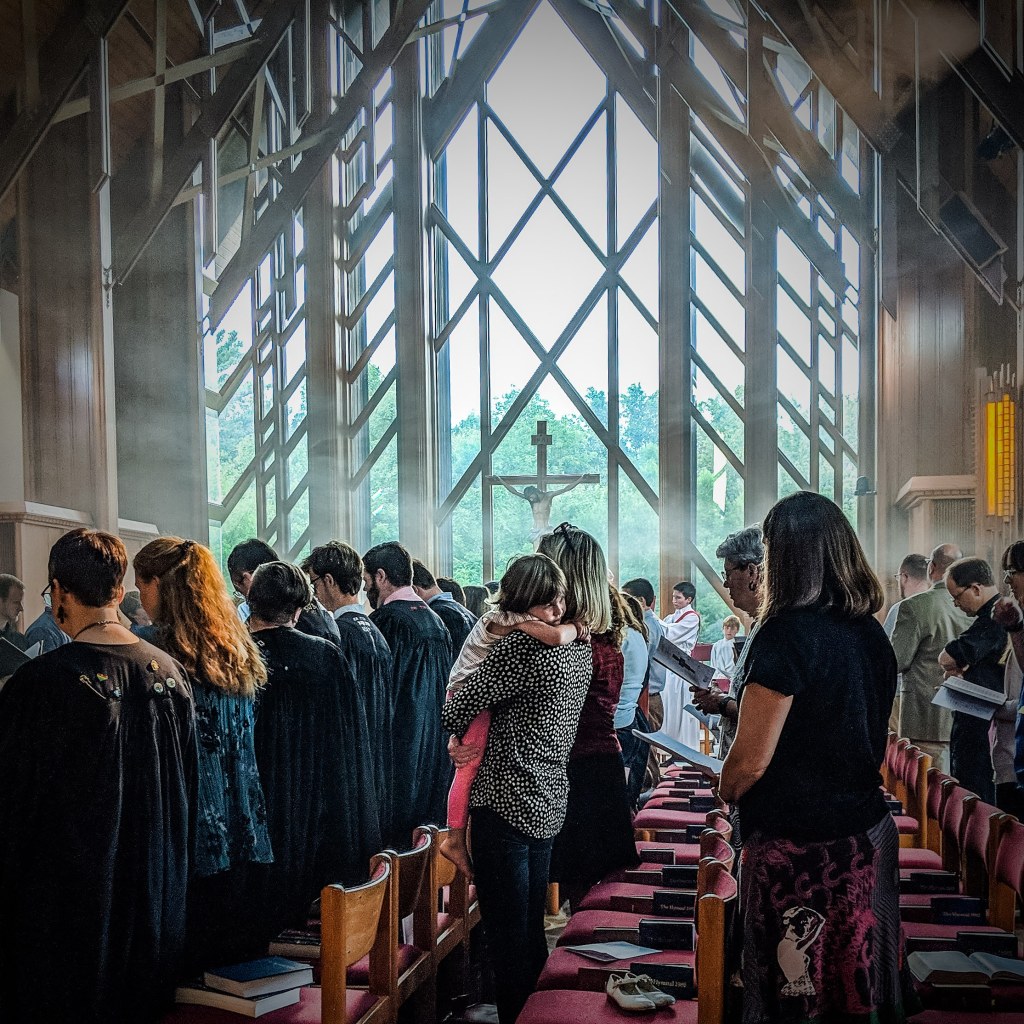
• beyond the barriers

    Pentecost 2 (Proper 5A)
    Matthew 9:9-13, 18-26
    All Saints’ Episcopal Church, Austin

    Today’s Gospel reading shows us that the Spirit that brings us new life is always going to show up where we expect it not to be, and that is what makes it new.

    The reading from the Gospel of Matthew is weaving together a few vignettes. I count at least three. Maybe you count them a little differently. We’re getting into the part of the year where it’s the first green Sunday, if you’re paying attention to that kind of thing, and for the next six months we will just be reading through the Gospel of Matthew paragraph by paragraph. So when I looked at this passage for the first time, I wasn’t really sure why these paragraphs were put together for us to hear today. Jesus first calls to Matthew and then goes to dinner with him and other unspecified “sinners,” then interrupts his meal to go and heal a woman who has been bleeding for 12 years and raise a girl from the dead. 

    Jesus in each of these little scenes is spending time with people that he is not supposed to be spending time with, if he wants to be seen as a good, upstanding, pious member of society. They will make him unclean, a social pariah, at least temporarily. Perhaps this is a little more obvious when a group of people who Jesus frequently butted heads with ask Jesus’ followers why he is spending time with tax collectors, who extort their neighbors and collude with their enemies They ask why he’s eating with “sinners,” which in other passages throughout the gospels is taken to mean people who engage in prostitution. Jesus’s opponents aren’t just being petty; the scene is shocking because the dinner table is full of war profiteers and strippers. Why is Jesus proud to befriend these people?

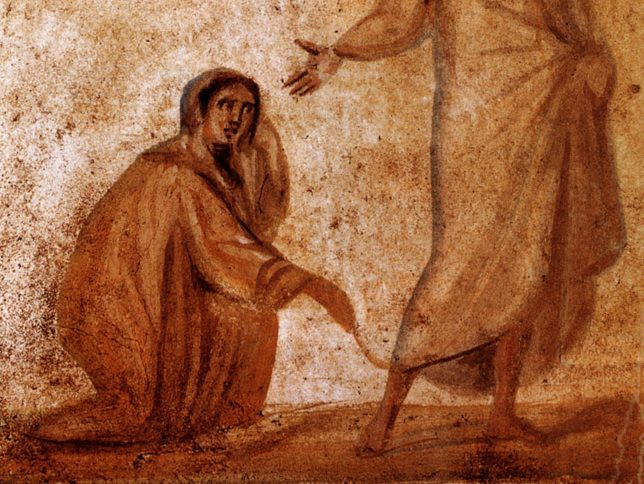
    From there, Jesus starts touching unclean people: first a woman who has been bleeding for over a decade, then a dead body. For a faithful Jew, these things would have made you unfit to participate in the life of the community until you had become ritually clean again. The woman herself, because of her condition, would have been considered unclean, and so in all likelihood she has been someone most people aren’t associating with for that whole time. In all of these interactions—Matthew, the unnamed woman, the daughter of Jairus—Jesus is being very intentional in going beyond the boundaries of what would be expected from a good Jewish man. 

    This is one of the many, many times in the gospels where Jesus interacts with people and does things that make perhaps even us say, “Jesus, what are you doing?” And this is paradigmatic for the ways that we interact with Jesus today. 
Jesus is always going out beyond what we expect. Jesus is always showing up in people, in situations where we are not looking for him. He has always been this way, and today we are given a very good reminder of that. 
These interactions that Jesus has and the ways that the people around him respond make me stop and ask where I have encountered that in my life. Where have I had this reaction to Jesus? 

    A couple of years ago, I was at a clergy conference where we heard from a man named Daryl Davis, who made his career as an R&B pianist, touring with some of the greats like Chuck Berry and Jerry Lee Lewis. But the thing that perhaps he is actually most famous for is that, as a Black man, since the ’80s, he has been befriending members of the Ku Klux Klan. His goal is to build relationships with people who really want nothing to do with him and who most of us would expect that he wants nothing to do with, to help them see that he is a person. In the interviews and articles you can find, it’s incredible to hear the ways that he leans into the unlikelihood of the friendship being its own justification. In many cases, the friendships that he has built with these virulently racist people, who most of us would want nothing to do with, has led to many renouncing their beliefs and hanging up their hoods. “You can’t beat the meanness out of a mean dog,” he says. “You can’t hate someone out of hating. But you can love them out of it.” I remember sitting there and feeling my heart harden. Surely this isn’t really how we make peace. Surely we shouldn’t be expecting this man, of all people, to be doing this. And yet there he was, doing it. By crossing the line and sitting down with them, with no agenda other than friendship, Davis has brought people back to life from places that I think most of us would be happy to leave them in. They credit him, in their own words, with saving their lives.

    I’m also thinking of a woman I met many years ago when I was living in Philadelphia. There was this bar called Bob and Barbara’s, known for live jazz many nights of the week. But what really kept me coming back was the Thursday night cabaret hosted by Miss Lisa-Lisa, a very large personality, somebody who you cannot ignore and she wouldn’t want you to. There’s one night I remember in particular, as Miss Lisa performed “My Way” by Frank Sinatra, which is of course a loud and proud song about perseverance and overcoming the many challenges that life throws at you. I’ve heard this song plenty of times, but that night, there was something about the tone in her voice and the strength in her spine and the look in her eye that, showed me something beyond words about this woman who had been through it, who had found something that gave her the strength and the healing to carry on, and she was here to make sure you knew about it. And even though she didn’t mention God, Miss Lisa took me to church that night in that dark little bar on South Street, on a tiny platform next to a Hammond B-3 organ. I’m not sure what made that night different from the others. It might be the only specific memory I have from any of the nights I spent at Bob and Barbara’s, but something about that night and that performance imprinted itself on my memory. I realized later that part of what gave that moment its authority was because Miss Lisa knew where she had been as a transgender woman and came through the other side of all the challenges and obstacles put in her way. Much like the woman who had the audacity to reach out and touch Jesus’s robe, Miss Lisa knew what it was like when someone has the audacity to stop and listen to the story of a woman who has been told to stay out of the way and simply suffer. Jesus could have ignored her or condemned her audacity or confirmed the prejudices of those around him. Instead he tells her to go in peace and claim the wholeness that God had given her and had always intended for her. I know that saying that to most American Christians would be very challenging. Most American Christians would not be able to recognize the work of the Spirit of life, of the spirit of God in trans people. But people like Miss Lisa and Daryl Davis and the many trans people I know are all people who today make those around them go, “What are you doing? 
What do you mean you’re gonna go over there, do that thing, talk to those people, and squeeze some new life out of it?”

    That is what Jesus is doing in these readings. Jesus is hanging out with people across the barriers that we set up. We serve a God that doesn’t need binaries. We serve a God who is, in the words of Paul, breaking down the dividing wall, reconciling all people to one another. In these stories, Jesus reminds us that no one is beyond redemption. No one is beyond the new life that Jesus is bringing into the world. No one, not even those who are dead, not even those we have given up for dead, are beyond what God is doing. And that is the best news of all. 

    There are people in our lives who, whether we would like to or not, we have written off. We believe that there is nothing that can be done for the situation. There is nothing good that can come out of that person or that relationship. 
There may even be parts of our very own selves that we have written off. Nothing is beyond new life. Nothing is beyond redemption.
 Not even you. We need to remain open to that. 

    When we come to this altar and receive the bread and the wine that is the body and blood of Jesus, we are committing ourselves to being like Jesus and asking for help to go where he goes, beyond the barriers, beyond the binaries, to find the places that need new life and to offer that life in his name. 
Let us remember who Jesus is. Let us remember that feeling of where are you going, and then not let that feeling hold us still in fear, but then follow him and go where he leads, so that when he says, “Follow me,” we, like Matthew, can do nothing else but get up and go.
  • Maundy Thursday
    Exodus 12:1-14
    Psalm 116:1, 10-17
    John 13:1-17, 31b-35
    All Saints’ Episcopal Church, Austin

    Holy Week offers us a rich tapestry of images. We began on Palm Sunday with the triumphal entry of Jesus into the city of Jerusalem, with his followers waving palms and crying, Hosanna, save us, Lord. Tonight, of course, we dwell on the images of Jesus’s last supper with his followers before the agony in the garden of Gethsemane, which we will commemorate later at the Night Watch after the service. Tomorrow brings us the violent and upsetting center of the story: Jesus’s trial and torture and execution. A little bit of quiet on Holy Saturday as Jesus’ body rests in the tomb while he descends to hell to break open the prison cells of the dead, which we will then celebrate at the Vigil on Saturday night, recalling the whole scope of the story of redemption beginning with the waters of creation through the passage through the Red Sea and Ezekiel’s valley of dry bones, and the cry of victory at the empty tomb, a revelation that all is not lost, that there is a love stronger than death. If you want to understand the Christian story, the images of Holy Week lay it all out for you to dwell upon, long after the words and the music have faded.

    For many years Maundy Thursday has been my favorite day of this week. It is the coziest image. There’s something almost sweet about it. Jesus cares for us, his followers. He does this very caring, nurturing thing by washing our feet and feeding us, and not just with any meal. As one writer put it, he gathers “with his faltering friends for a meal that tasted of freedom.” Every year on this day we hear this passage from Exodus describing the first Jewish Passover. The story of the Exodus is the key to Holy Week in a lot of ways. The events of these three holy days are about Jesus taking the same act of liberation that God performed for the Hebrew people and flinging the doors of God’s family wide open, offering that freedom to everyone in every generation. 

    In the story of the Exodus, God liberates God’s chosen people from a particular oppressive system: a particular king, a particular history of enslavement and abuse. But the kings and the false gods of Egypt are very much still with us in leaders and systems who demand tribute in blood and warfare, who demand the stripping of human dignity, who demand labor and production at any and every cost. In the story of Holy Week, Jesus very consciously reenacts the liberation of the Hebrew people on a much larger scale: liberation from the power of Death for all of humanity and the creation itself. It is not accidental that tonight we remember the story of the first Passover and on Saturday we will remember the story of the Hebrews crossing of the Red Sea. That is the emotional core of what is going on in these stories, in these images. I often come back to the line from the theologian Stanley Hauerwas when he reminds us that “God is whoever raised Jesus from the dead, having before raised Israel from Egypt.” So yes, Maundy Thursday is a very cozy, nurturing, warm scene. And it is not only that. It is Jesus showing us the ways we live in our own lives the freedom that he is about to secure for us. It is the beginning of our own exodus, our own raising as Jesus begins to bring us with him out of the graves of our lives.

    In Exodus Moses instructs the people about the Passover lamb and the sacrifice that is required for them to be saved from the judgment that is coming. Throughout scripture God is very clear about where God stands in relationship to the systems of the world that bring death and oppression and captivity. It begins here in Egypt. The first thing that God does for the Hebrews, the first thing that God does for God’s people in every time and place, is to free us. But the story of the first Passover reminds us that freedom does not come simply for the asking. It does not come without a cost. It does not come without commitment. In this story, the commitment and the cost is a life, a sacrifice. God institutes the sacrifice of the Passover Lamb as a counterpoint, as an answer to and a negation of all of the unholy sacrifices that Egypt had taken from the Hebrews, all of the lives unwillingly crushed and ended in the course of their enslavement. God looks at that and answers with a death that changes and ends all that. On the night of the Passover, Jesus shows us that he will become that sacrifice for us. His body will be broken, his blood spilled and spread over us as a sign that we no longer live under the power of gods who are not our own. God raises us up and sets us on a new path, not to serve the agenda of powers that have no care for us, but to serve and be served by one another in a community of mutual care and flourishing. Through his death Jesus brings life, and that abundant.

    The sacrifice that frees the world has been accomplished once for all, and all we have to do is to remember it with thanks, as we do every time we gather at this table for a meal that tastes of freedom. The only commandment that Jesus has ever given us is to love each other. Our response does not have to be complicated: it is simply to remember what God has already done, set our misgivings and suspicions aside, and serve one another as he has served us, giving thanks all the while. The psalmist gives us language: How can we possibly repay the Lord for all the good things that God has done for us? Let us offer the sacrifice of thanksgiving and call upon God’s Name. 

    We gather this night to begin—begin the great reenactment and remembrance of the stories of our liberation and of the liberation of all humanity from the power of death, from the gods of Egypt. Cast off the shackles of pride and shame, and serve one another here at the foot washing. Wait for even one moment with the sacrament of Jesus’ Body and Blood in the chapel later tonight. Let your reflection and your thanksgiving be manifest in your actions. That’s why we do this. That’s why you’re here.

    This tapestry of images that Holy Week offers us is more than any one week can hold. That’s what makes them beautiful and worth revisiting year after year. But we do not walk this way again because they are beautiful. They are for living. They are for showing us a new way to be. They are for our liberation. And tonight, Jesus shows us how.

  • in every way that we are

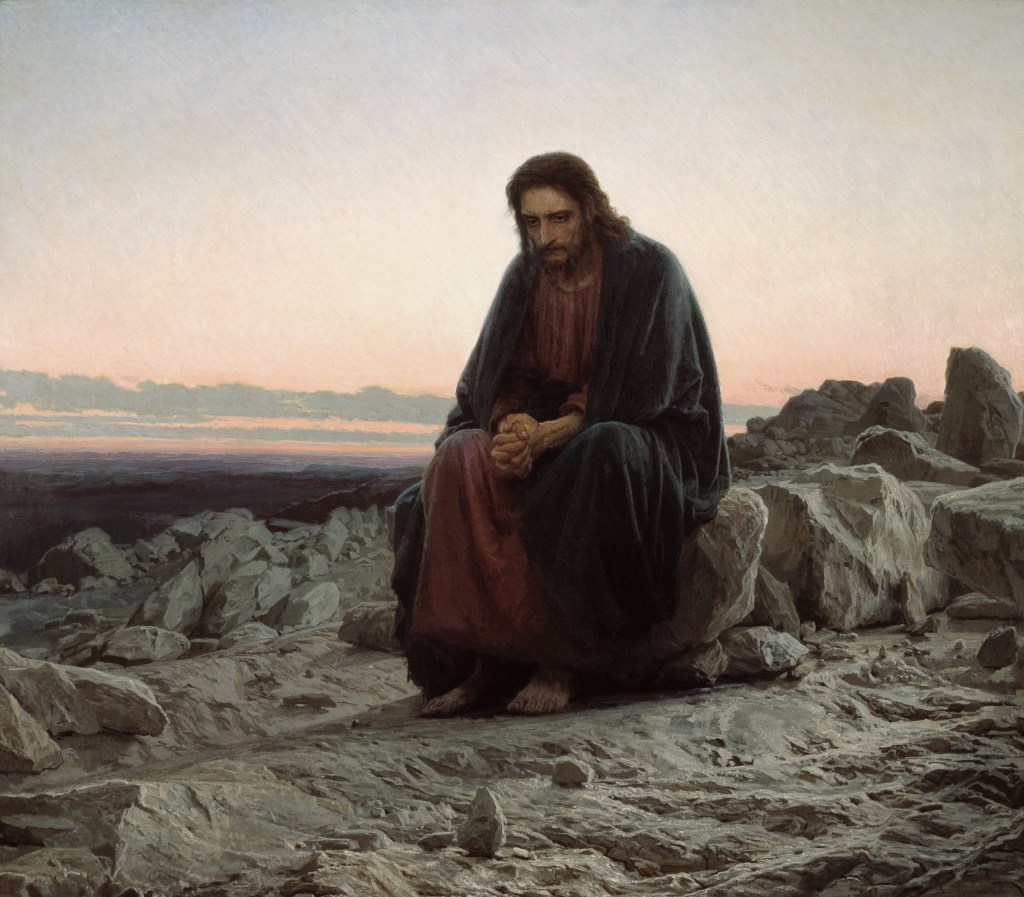
    You can watch this sermon above at 31:30. | Artwork: “Christ in the Desert” by Ivan Kramskoi, 1872

    Lent 1A
    Genesis 2:15-17; 3:1-7
    Romans 5:12-19
    Matthew 4:1-11
    All Saints’ Episcopal Church, Austin

    The longer I do this thing called being a Christian (and maybe more to the point: being a priest), I have learned that there are some things about the Christian life that are widely known, but poorly understood. Lent would have to be one of them. There’s a concept of it out in the wider culture, but when you talk to people about what Lent is or isn’t, you often get an answer that doesn’t quite capture the whole picture. At the noon service on Ash Wednesday you might have heard me say that it bears repeating that Lent is not a 40-day self improvement challenge just to see if you can do it. Nor is it a season of self-flagellation where we focus on the worst parts of ourselves and talk ourselves into trying harder to make ourselves worthy of God’s attention. It will be more helpful to us if we remember that Lent is a season of preparation, a season of taking a spiritual inventory. Spiritual spring cleaning, if you will. 
This season always precedes Easter: We’re working towards something, and we are invited to take some time to tidy up the desk and make sure that everything is where it needs to be, so that when we arrive at Holy Week we are able to listen, able to pay attention, able to understand where God is active in the world and in our own lives. 


    It is no mistake that the Church invites us on the first Sunday of the season to remember who Jesus is, so that we can have a better understanding of what Lent is. Jesus is another one of those things: widely known and poorly understood. In Genesis we hear the story of Adam and Eve and the serpent, and the fracture of our first ancestors’ friendship with their Creator. As we do every year on the first Sunday in Lent, from the Gospel we hear the story of Jesus fending off temptations in the wilderness, immediately after he has been named by God as his beloved Son. These readings offer a couple of counterpoints about people who had unfiltered access to the love of the Creator, which is something that most of us don’t actually know anything about. 
It is not something that we have experienced in the same way. Paul’s reflections in the reading from Romans offer some commentary on what these two stories have to do with us.

    Paul is trying to understand something about who Jesus is in relation to the rest of humanity. From the very earliest days of the movement to follow the way of Jesus, the Church has struggled to find a way to talk about Jesus that doesn’t make him less than who he is, nor more than who he is. 
We are trying to find something that defies easy understanding. It is important for us to remember that Jesus is not just a human with supernatural fortitude, which is something maybe we could get from the gospel reading. But neither is Jesus an alien with powers that have nothing to do with what you and I are capable of. Jesus is fully human in all the ways that you and I are and Jesus is fully the enfleshment of the love of the Creator that spun the universe into being. 
Jesus is both of these things at once, neither overriding or cancelling out the other. That’s actually incredibly important. 

    In the stories of Jesus’s temptation in the wilderness, we see how incredibly human Jesus is. Later in the service, we will say a prayer that contains a phrase that I really love, that Jesus was “tempted in every way that we are, yet without sin.” 
The tempter comes to Jesus in the desert and offers Jesus the same things that he offered to Adam and Eve; the most reasonable things in the world, in fact. Take what you want. More than that, take what you need. Eat something! When the snake—who was crafty after all—comes to Eve and says, “Did God really say hold yourself back from good things that you need?” he is offering what is by all appearances wisdom and nourishment. In the same way, the tempter comes to Jesus and says, “Take control of your own destiny. 
Don’t leave it up to somebody else. You have the power. I know you do. 
Did God really say not to do that?” These are the temptations that are offered to you and me every day, in some way or another. We all have desires, for something that we think we need in order to make it through our lives or even just the week. We certainly have plenty of desires for things that just looks really good to have. 
We all, in our own ways, crave control, not leaving our lives up to the input or whims of others. When we give into these temptations, so often they come at the expense of others. These temptations that Jesus experiences are the most human things imaginable. 
And what makes his story different from ours is that he does not give in to them. He stays committed to who he is, grounding himself in that unfiltered connection to God. 
Jesus makes choices in this story, that’s true. But the moral of the story is less about what he does than about who he is and his ability to stay grounded in that relationship in a way that we struggle to. The moral of the story is not, “Do what Jesus did, just try harder.” The moral of the story is not to work your way into God’s good graces. 
The moral of the story is stay grounded in who you are already: beloved, chosen, filled with the spirit of God. 

    This is what Paul is trying to get at in the reading from Romans. One of the things I really find helpful in reading the New Testament is to remember that these are collections of writings of people who are trying to figure out what is going on. 
They are trying to figure out who Jesus was. This is one of Paul’s attempts. If Jesus was able to do what he did—the miracles, the healings, the death, the resurrection—then he must have been like Adam in some way. He must have been, in some way, connected to God in a way that was unfiltered. Paul contrasts these two examples, Adam and Jesus. If Adam had that, and didn’t use it well, tried to grasp control for himself, and if Jesus had that and trusted it completely, stayed grounded in it, let it define who he was, then that makes a lot of difference. 
Paul knows, as we all do, that we are all born into stories that are already in progress, some of them quite old. Our families can only raise us with what they know. Every child is innocent of wrongdoing at their birth, yet every child is completely at the mercy of a society that is going to fail them and of parents that will fail them despite every best effort. We don’t get it right. 
None of us do. None of us have. This is what we mean when we talk about original sin: that Adam and Eve did something that broke a relationship, and passed it on to their children. They passed it on to their children, and so on and so forth and wider and wider, down to our own day. Things are a bit of a mess. When Jesus comes onto the scene, he is a kind of new Adam, another person who had this gift of unfiltered connection to the love of God. But Jesus did something else with that gift. If Adam can make one choice and cause such destruction, then what happens when Jesus has that same choice and uses it to offer an unfiltered gift of life to you and to me?

    As we begin Lent again we are called to reflect on where these patterns of sin have a foothold in our lives, where it has been passed on to us, where we are passing it on to others. But here at the outset, the Church reminds us that you are not doomed to keep passing it on, not doomed to failure through Adam. The passage that we hear from Romans today goes on in the next few verses to the passage that we will hear in a few weeks at the Easter Vigil. 

    Don’t you know that all who were baptized into Christ Jesus were baptized into his death?… If we were united together in a death like his, we will also be united together in a resurrection like his…. Death no longer has power over him. He died to sin once and for all with his death, but he lives for God with his life. In the same way, you also should consider yourselves dead to sin but alive for God in Christ Jesus.

    When we are baptized and when we commune with God here at the altar rail, we are filled with the same spirit of Jesus that kept him grounded in who he was as a beloved child of God. 
That is why we come here to be reminded who we are and that we have what we need. That is what Lent is about: to examine what in our lives is distracting us or taking up too much room, pulling us away from that divine spirit that already lives within. It is about finding ways to pay attention to what God is doing, to give thanks for what God has already done, and to let it pull us forward. You can tell a different story. Not a story of sin and separation, of death and destruction, but a story of life, belovedness, connection, and freedom that spring up from our own encounter with God, and that we can then share with others, and so on and so forth and wider and wider, world without end.

  • for such a time as this

    Ash Wednesday
    Isaiah 58:1-12
    2 Corinthians 5:20b-6:10
    All Saints’, Austin

    Many years ago a national emergency brought a certain country to its knees. Pressures from within society and from foreign powers drove national anxiety through the roof. Polarization and division taught the people to distrust one another. Ancient fault lines in the nation’s identity were exposed. Unjust rulers exploited those divisions for their own gain, gathering power and wealth to themselves, committing atrocities against their own people, and plunging the nation into wars. In the end all came tumbling down; the government collapsed and left the nation a ruined husk of itself, with the people wondering what came next and what to make of what was left behind. You may be able to guess that this could describe any number of times and places. It’s an old story. Today I want us to consider three such cases.

    I.

    The year was 500 BCE and the nation was the tribes of Judah, returning to their homeland after the failure of their kings led to generations of captivity in another country. They stand among ancient ruins, foundations of a life that no longer exists, struggling to rebuild. It was never going to be easy, but things are not going well for them. When I hear Isaiah chastising the people for their hypocrisy it is easy to imagine that the group he is addressing must have been a smug, self-aware bunch. We’ve met these people, right? For years I have heard a note of sarcasm in the questions the people ask in this passage, “Why do we fast, but God does not see? Why humble ourselves, but God does not notice?” But a more careful reading of the passage shows no such double-dealing on their part. The way Isaiah puts it seems to show that there is genuine confusion. It’s his book, he can put it whatever way he wants; so this more sympathetic or at least neutral framing must be significant. This is a group of people who are trying to encounter God, after all, whatever their motivations may be. The prophet describes them as people who seek God “day after day” and “delight” in doing so. How many people do we know who delight in seeking God? I could describe my spiritual life in a lot of ways, but “delight” isn’t a word that rises to the top of the list for me. The people want to know God, to feel God’s love and protection in a dangerous time. But the prophet notes a problem. It may seem obvious to us but it was not obvious to them. They were putting their religion into practice, following the customs of their ancestors in the places where their ancestors worshiped, and they are leaving their worship unchanged, unconverted, unconvinced. They have not encountered the God they delight in, and they know it, even if they don’t understand why.

    Isaiah’s diagnosis and prescription is clear: change your hearts and lives. God is not saving you individually in response to what you do or don’t do and how well you do or don’t do it. God is saving a people, an entire nation. Show your care for others not with words but in action, and let God’s healing be displayed in the sight of all like a light shining in the darkest night.

    II.

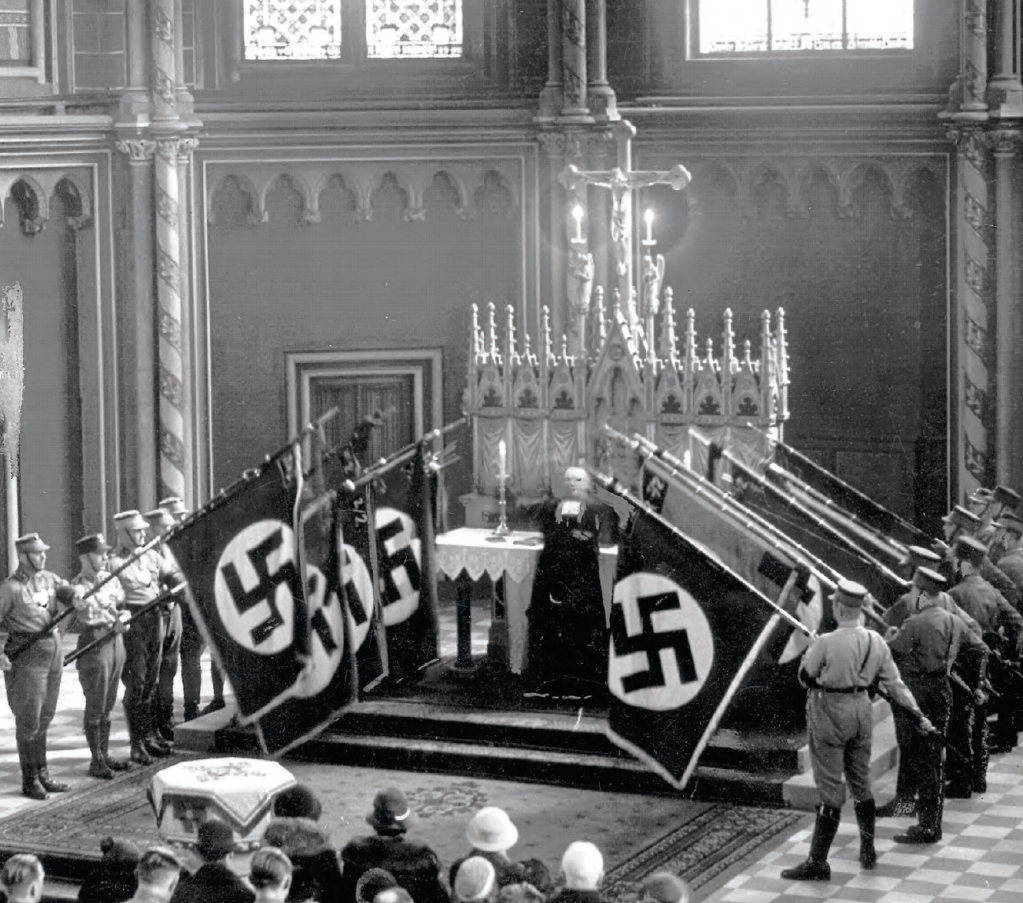
    The year was 1945 and the nation was Germany, fresh off the devastation of the second World War and the violent end of over a decade of rule by the government of Adolf Hitler. In the aftermath of the war, in the rubble of Germany’s cities, it was the Church that looked to its past to understand how they had gotten here before they could begin rebuilding. In the 1930s the large majority of Germans identified as Protestant Christians, and in the early years of Hitler’s rule there was a concerted effort to reform the German churches from within, using their influence as a way to promote racist and totalitarian ideology by blending it with traditional Christian teaching. In its final form, this so-called “German Christianity” sought to strip any indication of Jewishness out of the story of Jesus and declare “a new revelation” with a racially purified German nation as God’s chosen people. This was not a sideshow. It was accomplished with the happy compliance of many German pastors; some of the most chilling images I’ve ever seen are of the churches that proudly displayed the Nazi flag in their sanctuaries. In 1934 another group of church leaders who saw the danger for what it was formed a group called the Confessing Church, which insisted on orthodox Christian teaching and resisted this reform movement openly. They paid for it with political persecution, imprisonment, and martyrdom.

    Six months after the fall of Hitler and again two years later, German church leaders issued statements confessing their sins that had opened the path for such evil to thrive. “We accuse ourselves for not witnessing more courageously… and for not loving more ardently.” “We went astray, as we felt compelled to form a front of good vs. evil, of light vs. darkness, that falsely created… a polarization of the righteous vs. the unrighteous in political life…. We adulterated the free gift of God’s grace to all and abandoned the world to its own self-destruction….”  (see The Stuttgart Declaration and The Darmstadt Declaration)

    It’s estimated that only about 10% of the German population were ever actively working towards the goals of the Nazi agenda. Another 10% were actively working against it. Most were in the middle, quietly supporting or quietly trying to lay low. These statements of confession from the German church were being made by those who had been in the government’s crosshairs—and they took responsibility for their own contributions to the catastrophe anyway. They named a national sin on behalf of their neighbors who were not ready to do so, and repented on their behalf anyway, as a sign that the gift of God’s forgiveness and reconciliation is available anew in every time in the face of every atrocity.

    III.

    The year was 2026 and the nation was our own. 

    You don’t need me to rehearse the events of the past several years or even the past several weeks. But we can take our cues from the times we have been here before. Lately I’ve been reading For Such a Time as This: An Emergency Devotional by Dr Hanna Reichel. Dr Reichel is a German scholar of Christianity in the Nazi era who teaches at Princeton Seminary in New Jersey, and this past fall they published this short collection of reflections on how to respond faithfully in times of authoritarianism. They encourage us to follow the example of the German churches’ confessions of sin in 1945 and 1947. They encourage us to own what we have done and left undone and to do it sooner rather than later. They write, “A reckoning is necessary, not to lacerate ourselves while evil triumphs, but to understand and disavow what fuels its rise. Repentance is required, not to add insult to injury, but to reclaim agency by taking responsibility.”

    This is one of the things we gather here to do today, among the many sins and shortcomings available for us to confess. Perhaps you find yourself confessing the same things from one year to the next. Perhaps you aren’t entirely sure what you’re here to confess but trust the liturgy to do the work. Every year we walk this way into the season of Lent and every year it bears repeating that Ash Wednesday is not the grand kickoff of a 40-day self-improvement challenge, or a day of fasting for its own sake as if checking the box will get God to pay attention to us. Ash Wednesday is about taking responsibility for our share of what went wrong—and yes, even interceding to God and repenting on behalf of our neighbors—so God can draw near to us and empower us for the hard work of choosing to do something else, long after day 40 has come and gone. “The sacrifice of God is a troubled spirit; a broken and contrite heart, O God, you will not despise” (Psalm 51). Dr Reichel draws on the work of the historian Hannah Arendt to reflect that the rise of generational evil is greatly aided by “ordinary people [who] neglect to reflect and fail to resist actively…. For God’s sake, don’t be a bystander.”

    In his letter to the Corinthians, St Paul exhorts us not to receive the grace of God in vain. We who have been filled with the spirit of Jesus will, by definition, run up against other powers in the world that seek only to belittle, steal, and kill. Paul’s sufferings which he recounts for us today are a result of his refusal to go along to get along, his insistence on the dignity of others, his declaration that Jesus’s kingdom subverts the claims of the powers that be. Paul never tells the Corinthians or us to go get martyred, but the message here is clear too: following Jesus has a cost. It will be up to you to figure out what that is with the help of mentors and trustworthy guides, but start however you can, however small you can. 

    Whatever else may be going on in the world, Christians never move beyond our own need to hear the gospel: now is the acceptable time, today is the day of salvation. We have been called to display the death and new life of Jesus Christ to the world, in the words of the old prayer, “not only with our lips but in our lives, giving up our selves to God’s service.”

    Hear once more the words of the Confessing Church: “Do not allow doubt to become your Lord, for Christ is the Lord. Bid farewell to every kind of faithless apathy. Do not permit yourselves to be misled by dreams of a shining past or by speculations about an impending war. Rather, in deep sobriety, be conscious of our liberation and of the responsibility that every one of us carries in the restoration of… [our] public life, that will serve human rights, social welfare, internal peace, and the reconciliation of the nations.”

  • notes on the wilderness

    You can watch this sermon above at 26:30.

    Advent 3A
    Isaiah 35
    Matthew 11:2-11
    All Saints’ Episcopal Church, Austin, Tex.

    Over the millenia, a consistent topic of inquiry in human thought has been the wilderness. What is it and what does that have to say about who we are? Is it a place of danger or a place of awe and beauty, or something else? Are we part of it, or are we meant to master it? Many of the first chapters of the Book of Genesis offer some possible answers to this question, beginning with the fact that God places the first humans not in a bustling city, but in a garden. We do not stay there long, of course, as our first ancestors are quickly driven out of the garden into a place of desolation and danger, a place that will demand much of them if it is going to be survived. They quickly learn that death of one kind or another seems to be the cost of doing business, beginning with the animals whose skins they are wearing. But the wilderness demands interdependence as well; we all live or die together. We will all need one another in order to make it.

    The high-level question of settlement versus wilderness, community versus chaos, can arguably be seen as one of the primary lenses through which one reads the scriptures. A few chapters later we are confronted with a stark lesson when the peoples of the earth gather to “make a name for themselves” (as the author puts it) and embark on history’s first civil engineering project: the Tower of Babel. This too ends unhappily for those involved. The promise of connection and an effort to build a monument to human power ends with the people separated and unable to understand one another. From this point forward, the authors of scripture seem to be generally skeptical of what happens when humans live too closely together. 

    Famously, of course, the Hebrew people are eventually enslaved and forced to build cities as monuments to Egyptian progress. After they are liberated from their enslavers by the God of their ancestors, they are led out into… the wilderness. Where else? There is nowhere else to go. As they journey towards the land of promise, they are transformed slowly from a people who only know what to do when someone tells them to do it, to a people who are able to exercise some kind of agency within the liberation that God gives them. Throughout scripture, the wilderness is not only a place of danger or deprivation, but the place where God forms a people capable of genuine community and all that comes with it. What follows when the Hebrews arrive in the promised land can, in some way, be seen as a critique of the ways that they go back to where they started, falling back into old habits. Before long, they are yearning for protection back in the city, this time Jerusalem, justifying their need for a king and a temple when God more or less explicitly advises that these are not good ideas.

    Cities are seen throughout scripture often as dangerous accelerants of the human tendency to exploit others for personal gain, where political and economic power is consolidated and then wielded. Cities are seen as places where the prosperous use what they have gained from others, probably unfairly, to live in ways that the common people are unaccustomed to. Many of the most prominent voices in scripture are people who are at the mercy of those in the halls of power, and when we hear stories of those who make the transition from the underside of society to wearing soft robes in royal palaces, they are frequently showcased as examples of What Not to Do.

    By the time that we arrive at the life of Jesus it is no great wonder that one of the first characters we meet in the Gospels—Jesus’s cousin John—has done something unexpected and perhaps foolish in the eyes of those around him. He has abandoned the pleasures and protection of the city and gone out into the wilderness. John appears in the wilderness preparing the way for a savior who is perhaps not quite well understood yet, even by him. After Jesus’s fateful encounter with John when he is baptized, Jesus himself stays in the wilderness for forty days as he undergoes his own transformation and preparation for the work ahead of him.

    There is plenty that could be said about what kinds of cities and systems of power we live under today, which are self-evidently not providing anything like true community for the vast majority of people. Eight out of ten Americans live in urban and suburban areas; up from about 50% a hundred years ago and 7% a hundred years before that. We have undergone a radical transformation in a relatively short period of time. It is a great sorrow and no small irony that we are more disconnected and alienated than ever. Many of the realities that we live with expect and often demand that we regard our neighbors with suspicion, if not outright disdain. It is taken for granted that I do not really need to know the names of any of the neighbors in my apartment building, let alone have an actual relationship with them. Comforts and conveniences that we are accustomed to come at the cost of the well being of others, and this is treated as if it is no great concern. All of this is simply the way things are, because we have been told that this is the way things are, and questioning it frequently comes at no small expense. 

    The great gift of interconnectedness that the World Wide Web first offered us has curdled into a place where people of all ages, but especially our younger generations, are funneled into silos, increasingly detached from any hope of a shared reality and story with the people around us. To spend any substantial amount of time on social media (speaking from my own experience) is to be faced with the grim truth that interacting with an actual human being is no longer guaranteed or even the point. Like Babel, our systems promise connection but deliver fragmentation. Like the cities of Egypt, they demand endless productivity and celebrate progress while ignoring the very real human cost. The forms have changed, but the logic has not. We are pushed into wildernesses that merely isolate and kill, without the opportunity for transformation that the scriptural image of the wilderness often carries with it.

    Every Advent, we are invited into the wilderness by and with John, but not for the sake of isolation and despair. John calls us to prepare the way in our own hearts for the coming of the promised Savior, even if we do not exactly understand who he is yet. The way we are living will not achieve this on its own, and in fact may work against it. In the scriptural imagination, the wilderness is a place where our illusions are stripped away and we come to ourselves and to one another. It is the place where vulnerability becomes unavoidable, where the urge to control works against our best interest, and where the truth can no longer be ignored. The repentance that invites us to prepare the way for the new reality that is coming does come at a cost. But it is nothing less than our own willing realization that the status quo is no longer sustainable for us as individuals or as a society or for God’s good creation, wild and beautiful. We can’t keep living like this. John makes no promise that giving up what keeps us complacent or fearful will not cost us or be uncomfortable. He offers us no guarantee that the wilderness is any less dangerous than it has ever been. 

    The realization itself is not enough to prompt us to turn off the TV, put down the phone, and walk out into the great unknown. There is still the very real problem of our own fear to contend with. It is to this reality that the prophet Isaiah speaks when he offers us a vision of the wilderness that is not all desolation and despair and discomfort, but rather that the wilderness is the cradle of life itself. “Be strong, do not fear!” Isaiah offers us a vision of the wilderness that is plenteous, even beautiful. Jesus goes out ahead of us and wherever he steps the thirsty sandy ground bursts into bloom carpeted with roses, a new Eden ours for the enjoying. We can walk out into the wilderness on our own like John or be pushed into it by circumstance like the Hebrews. However we get there, leaving behind the familiar and the comfortable is where God starts working. It is where the slow and insistent work of restoring us to that original state of joyful union with God and one another can begin. The wilderness is a place where there is finally room for God to work.

    It is in the wilderness that we find ourselves transformed, ready to receive the gifts that trail in Jesus’s wake: sight that understands the present, freedom to walk confidently into the future, wellness and vitality that opens our selves to others, a listening ear for the movement of the Spirit: all of this life and that abundant. In the end, even our cities, our faltering attempts to be with one another, are renewed. The final image of scripture in the Book of Revelation is a great heavenly city coming down to join ours, a place where all of humanity and God are gathered together in peace and joy, world without end.

    In this moment, in this Advent season we are invited into the wildernesses of our lives. We are invited into careful discernment about what our values and assumptions bring into bloom. Are they the roses of Christ or are they the thistles of something else? We are invited to consider what the way we are living brings into being. Wilderness may look like choosing to be present to others even when it’s hard, choosing the dignity of others rather than convenience, choosing trust rather than the need for control—small decisions with real costs, where there is room for God to work. What can at least be said about the people of God, beginning in Eden and on down to our own day, is that we are called to be a people of interdependence: people who are radically committed to knowing one another, a genuine community outside the protection and falsehoods of the city. The Church is where this begins. The Church is where we are knitted into that Body of Christ which then goes out into the wilderness after him, following the path that he has already laid for us, ready to share what we have heard and seen: for our God has come to save us.

  • tools for fools, and other provocations

    Holy Cross Day
    1 Corinthians 1:18-27
    John 12:31-36a
    Texas Canterbury, Austin, Tex.

    Therefore he who shows us God
    Helpless hangs upon the tree;
    And the nails and crown of thorns
    Tell of what God’s love must be.

    Here is God, no monarch he,
    Throned in easy state to reign;
    Here is God, whose arms of love,
    Aching, spent, the world sustain.

    –W. H. Vanstone

    I.

    There’s a lot of violence in the news lately. I don’t just mean this week, though there is certainly plenty. Over the past couple of years, it seems that at least our awareness of the violence in the world seems to be intensifying and escalating.

    The news this past week of the murder of Charlie Kirk and the reactions to it are, of course, upsetting and alarming, but it is not the first step along the way. There have been other political assassinations, just this year, on both sides of the political divide. There is an incredible amount of rhetoric in the news and online, calling for the abuse and deaths of immigrants and homeless people. The ongoing conflict in Ukraine and ethnic cleansing in Palestine continues to worry people of all persuasions.

    This uptick in the normalization of violence in our society involves all of us. It impacts all of us. It isn’t about one particular week in the news. It points us to a deep illness that is playing out in every part of our political discourse: the conclusion that the only way to solve a problem is to find a person or group to eliminate. There are more and more people in the world, including Christians, who have put their trust in the power of violence, destruction, and death.

    I find myself thinking about past moments when humanity has found itself in particularly intense periods of violence. The Civil Rights movement of the 1960s in the U.S. comes to mind: another period marked by high-profile assassinations. Before that, the Second World War, the Holocaust, and the events that led up to it in Germany, and especially the role that Christians played on both sides of that question. 

    These moments, like the one we are living through, confront us with deep questions with deep consequences; questions about the kind of world that we want to live in, about what is a good society. For Christians, they also ask a set of questions about how we look to what God has promised to his children, and discern what we are called to do or not do.

    We gather today on the Feast of the Holy Cross. Of course, in every church you’ve ever been in, there is a cross. The one we have here behind the altar happens to be empty, but many have depictions of the crucified Christ on them. This is the central image of our faith: the shorthand by which most of the world knows the followers of Jesus. 

    When we find ourselves in periods of particularly intense violence and conflict, it would be a mistake for us to ignore that reality and say that violence has nothing to do with our faith. Not only would this be a mistake, it would be a lie. Our faith, symbolized by that cross, has many things to say to moments like these, and to people who are caught up in the cycles of violence that humanity has known so well in every time and place.

    II.

    Today’s reading from the Gospel of John comes right at the turning point in that book. Jesus is about to finish his public ministry of teaching, healing, and feeding. From this point onward, the story is very much concerned with the work he knows he is called to accomplish at Jerusalem: the events that will lead to his death, and which we now remember on Good Friday and Easter.

    Jesus understands and is dedicated to the course of events that will put him on this path. In this passage, he knows that his time has come to spring into action: “Now the time has come for this world’s ruler to be cast out, and when I am lifted up”—that is, crucified—“I will draw all the world unto myself.”

    The crowds he is talking to are confused by this. He has said things that make it clear that he believes he is the Christ, or the Messiah, the anointed one that God has sent to Israel. So they reply: “Well, you’re supposed to be here forever. If you really are who you think you are, what do you mean?”

    This is an important theme in John’s gospel: who does Jesus think he is? From the beginning of his book, John has been intentional about the ways that he portrays Jesus and the words that he has Jesus say. But when he opens the book he doesn’t just go back to the birth of Jesus, or Jesus’ family history, in the ways Matthew and Luke do. He goes back all the way to the beginning, to Genesis chapter 1. In the beginning, God created. This is the first thing the Scriptures want us to know about God: that God is a creator, and that what God creates, God calls good. John puts it a little differently, though. Even if you are familiar with how he starts out, I’m going to read it for us all to consider:

    In the beginning was the Word
    and the Word was with God
    and the Word was God.
    The Word was with God in the beginning.
    Everything came into being through the Word,
    and without the Word
    nothing came into being.
    What came into being
    through the Word was life,
    and the life was the light for all people.
    The light shines in the darkness,
    and the darkness doesn’t extinguish the light.

    When Jesus comes into the world, he teaches us a lot of things. Many people love to engage with Jesus as a great teacher. But John calls Jesus the Word with a capital W; in other words, the very essence or rationality of the eternal Creator. This Word brings everything into existence, and everything that comes into existence is full of life.

    This is the litmus test by which we judge whether something is from God, because it is the only thing Jesus knows how to do. If Jesus is the Word with a capital W in human flesh, walking around like you or me, then that becomes the light in which we evaluate all other things.

    What does this imply for all the other stories we tell about God and about ourselves? It is the light that is cast back even on the rest of scripture as we turn over this question: what does God have to say about violence?

    III.

    Jesus understands the values and the teachings by which he has oriented himself: life, love, healing, justice. These are the things by which he calls us to orient our lives as his followers. He understands that his commitment to this way of life is going to put him in conflict with people in power, and that his radical commitment to peace is going to get him killed.

    By willingly going to the Cross, Jesus intentionally, proactively, knowingly orients himself on the side of the victims of violence—not in spite of who he is, but because of who he is. He sees the fears which we are tempted to put our trust in, and the blood that those fears have spilled throughout history. He sees the helplessness under which humanity labors in these cycles of violence we know so well. 

    Jesus, fully God and fully human, sees our predicament and he says: “I will not play this game. I will not use my power to commit violence, even to save myself.” That is the God we follow. That is what God has to say about who God is. The only thing that can come into being through God is life. The God who is revealed to us on the cross does not, and cannot, counsel violence. 

    Death is a powerful force in the world. Its only goal is to undo the good creation that God has given to us. It loves find ways to decreate us, to uncreate us. Death uses the temptation to violence and abuse against other people as its most powerful tool.

    We follow a different path, a different God who has overcome death by subjecting himself to it, and this is the foolishness that Paul speaks of in our reading from 1 Corinthians. Faithful Christians, who follow Jesus to his logical conclusion, trust that violence ultimately has no real power. It is a tool for fools who don’t know any better. Death always consumes those who use it. But we proclaim Christ crucified, and lift up his cross as a reminder that we trust someone with more powerful tools to build the kind of world we hope to live in. It confounds us all. It makes no sense. It is a provocation for both those who have been part of God’s story for a long time and those who are new. 

    IV.

    John starts with Jesus’s role in creation at the dawn of time because he sees that work of creation as beginning anew in Jesus. In the beginning God created, and the new way of life that Jesus shows us on the cross is another beginning, of something new that is still working itself out.

    Throughout his earthly life, Jesus sees himself as part of that work. And having risen from the dead—having not been overcome by that death, not overcome by violence, not overcome by destruction, because he is life itself—he then gives that life to us.

    It is a new way of life, to walk in that light that Jesus continues to push forward into every darkened corner of the earth and to every darkened corner of every human heart. He hopes for us when we cannot hope for ourselves. He encourages us, calls us, beckons us to walk in that light. Not perfectly. Not because we earned it. But because we trust that it is a light that will not fail. This is not a light that simply exposes and embarrasses, but a light that enfolds and embraces, that gives warmth and love. It casts out fear, as love must. Fear is the source of all violence, of all temptation to destruction and despair, but it cannot withstand the love that lies at the heart of God, displayed on that Holy Cross.

    Some of you know I love to give away books, and that I have an entire wall of them in my office. As we walk through this time of conflict, we will need to heed the wisdom of our forebears. We are not the first to be here. We are not alone. We need their wisdom, and for these many hundreds of years, that wisdom starts with the Cross.

    We have been given a new way to be human. We are as good as dead to the urges of the world, to all its fears and desperations. We have been given a light to walk in, a light to hold, a light to shelter, and a light to spread to others. May it be so.

  • surprised by love
    You can watch this sermon above at 30:23.

    Proper 16C
    Hebrews 12:18-29
    All Saints’ Episcopal Church, Austin, Tex.

    In the Name of the true and living God, whose banner over us is love.

    It is a great comfort to me when I read scripture and realize that the people who wrote and read those words for the first time were perhaps not all that different from us. The author of the book of Hebrews, which we heard from a few moments ago, is writing to a group of young, new Christians living a generation or two after Jesus, and they are tired. This is a group of people who are feeling beaten down by the state of the world, by the constant onslaught of hardship and the temptation to despair. They are feeling the invitation to follow Jesus as more of a burden than a relief in a world that does not share the values of what Jesus called the kingdom of God. This is a group of people who are beginning to wonder if it’s worth it to opt out of society’s worst impulses and “live peaceably with all so far as it depends on them” (Romans 12). 

    Hebrews is one of the longer books of the New Testament and scholars believe that despite its common name of a letter, it is actually a sermon or maybe a series of sermons that have been stitched together. The Preacher is speaking to an audience in a way that makes it clear that they are very familiar with the Jewish law and the story of the Jewish people, hence a later editor who added the title “To the Hebrews.” So the Preacher knows her audience. They are getting tired, and her main goal is to encourage her audience, exhorting them to stay the course and persevere in pursuit of that beloved community that Jesus has promised them. The passage we hear today is following on from a section where she is particularly asking them to think about what it means to live holy lives, not in the sense of being particularly pious or sanctimonious, but in the sense of living lives that are set apart, lives that are different, lives that have examined the values they were raised with and charted a different course in the expectation that the last shall be first and the lost shall be found and the least shall be the face and the voice of God.

    The Preacher exhorts 
her listeners to remember why they chose this new way of being human and she arrives at our passage today where she is laying out a set of images. You have not drawn near to something familiar, something that can be reached out and touched, something that evokes fear. She’s drawing on scenes from the book of Exodus when Moses and the newly freed Hebrew people receive the Law from God, and she says to us that we who have chosen to follow Jesus are not there. You have not come to a mountain that is smoking and trembling, and everyone is scared to death. No, you have come to a different mountain, to the very city where God dwells, to a place of rejoicing defined by this festival gathering of angels and those who have already gone before you. 
And so she is asking her listeners, which is to say us, to consider which of these scenes we want to place ourselves in. 

    Over the past few days I’ve been thinking a lot about the news that broke on Thursday of the death of Dr. James Dobson, a name that may be familiar to some of you, the founder of the group Focus on the Family, based in Colorado. 
When he was starting out in the ‘70s, Dobson made a name for himself as someone who was giving parenting advice to Christian families, with books like Dare to Discipline and The Strong-Willed Child. I was talking to a friend the other day and we realized that even though he and I grew up about 20 years apart, when it came time for our parents to tell us about the birds and the bees, they both handed us a copy of the same one of Dobson’s books (for myself, I don’t remember it being especially helpful, even if it was technically accurate). Dobson’s style could fairly be described as authoritarian. He is someone who is interested in parents demanding the respect of their children. 
He emphasizes corporal punishment and withholding affection. Dobson was trained as a psychologist, as a matter of fact, and this lended him some credibility, but he found his way into this particular line of influence as a result of his concern about what he saw as moral decay and social decline. And in his mind that began at home, and it began with the way that parents raised their children. 
Over the decades, Dobson would use Focus on the Family to build on this crusade and eventually become an incredibly influential evangelical advisor in the world of politics. He advised multiple presidents and lobbied heavily against abortion access and LGBTQ rights. Those who have studied the role of Christianity in America over the past several decades would have to say that he is someone who happily laid the groundwork for the social and political predicament we find ourselves in.

    Dobson’s legacy is widely felt throughout the Church. I know many people of at least my generation who were taught that seeking love from their caregivers makes them a burden. 
We were taught that compliance is more important than honesty or vulnerability, and that this was the will of God. The language and imagery of Christian faith has always run thick with familial relationships–we speak of God and indeed sometimes our clergy as father and mother; we refer to each other as brother, sister, sibling. This has always been true, and so when you rear children to view their parents as fundamentally people to be feared whose love needs to be earned by compliance, and then fuse this with the language of faith, that is a very potent mix indeed. 

    It wouldn’t be fair for me to stand here and say that Dobson invented or even popularized the idea of people being afraid of God. Many Christians before him, indeed many people of all religions in all generations, have weaponized God and clothed God in the suit and tie of a tyrant. Many people’s first lessons in Christian faith are those that teach them to relate to God in the way they relate to their parents, and so the way we teach our children to relate to their caregivers and to all those in power over them matters deeply. Dobson was right that the moral order of our society starts at home. It is not hard to look around at our city and our nation, to see the relationship between the common people and the powerful, and find that we are being pushed forward by fear of many kinds, but especially a fear of authority and a compulsion to quietly comply with violence even when the facts of the matter are clear. We tell ourselves if we make ourselves small and stay in our own lane, if we live in ways that comply with the wishes of the strong and avoid punishment, perhaps we will find the love we long for. Beloved, it has never been so, at home or anywhere else.

    As I’ve been reading reflections from folks who are responding to the death of Dr. Dobson, I came across one from Pastor Zach Lambert, who is actually a pastor here in Austin, and he shared this quote: “[Dobson] is being surprised by Love. I do not know if discovering the vastness of God’s love is hell for him, or heaven. Perhaps a bit of both. That’s above my pay grade. But Divine Love has him now.” I hear in this reflection the voice of the preacher of Hebrews. We may pray, if we wish, that Dobson has found himself not in the hands of the god of terror that he proclaimed, but has instead discovered the love and joy and belonging that is at the heart of God. We will have to let God sort that out. But it can and should be said that in the meantime there is plenty of healing that still needs to be done here on earth as it is in heaven, that there are plenty of people who need to hear the word of good news that our God is not a god of terror. Even for myself, this many years on, my own work of seeing God as someone who is my friend is ongoing.

    The God who brought the Hebrews out of slavery and raised Jesus Christ from the grave is not a God who demands our fear. God is the source and summit of love and of our joy. 
The world needs communities like All Saints’, like Canterbury, where all of us, but especially those who need healing the most, can learn to know and believe that we are already part of that festal gathering that the preacher describes at the foot of Mount Zion, the holy city of God. The Preacher paints a picture of a party, of a gathering in the heavenly courtroom where angels swing from the chandeliers, because there is one judge who is God and there is one verdict which is “not guilty.” Last night I walked with about 100 Episcopalians down Congress Avenue in the Austin Pride parade, a riotous celebration of those who have been freed from their prisons and who help us dream of a world where the need for physical, emotional, and political violence is done away with once for all. If you want to see an image of the kingdom of God, an image of what the Preacher describes for us today, I hope you’ll come with us next year.

    
The Preacher of Hebrews invites us to persevere in the way that we have already set out on, to find strength and carry on with what Eugene Peterson called “a long obedience in a single direction”, not because we have to, not because we fear punishment, but because there couldn’t be anything better. Because we have already tasted the first fruits of all the justice and joy that God has promised to the world and we are eager to share it with others. We have not come to terror; we have come to life and that abundant. We have not in these days come to the end of all things, but to the unveiling of what cannot be shaken, to the revelation of what must endure, which is that kingdom of God where the only law is love, where all know themselves to be most beloved children of the Most High God, and where the party goes on all through the night, world without end. 

    In the name of the God who has not called us servants but calls us friends. Amen.

  • lost causes found
    You can watch this sermon above at 30:50.

    Proper 10C
    Luke 10:25-37
    All Saints’ Episcopal Church, Austin, Tex.

    There is a particular image in the story of the Good Samaritan that I cannot get out of my head this summer. You know the story, even if we had not just heard it. A man leaves Jerusalem, is attacked and left for dead by bandits, a man who knows better passes him by, a second man who knows better passes him by. Freeze the frame there with me for a moment. The sun is high in the desert. The beaten man lays on the side of the road. His breath is shallow, his wounds bleeding. He is alive; Luke doesn’t tell us much but he does tell us that. He knows what has happened to him. He knows his prognosis is poor. He knows he is what most would consider to be a lost cause. He does not know what happens next, if anything. This is a blink and you miss it moment, but it is a familiar image if we take the time to let it be.

    This is possibly the most familiar story Jesus tells, the one that has seeped out into the culture even as church participation declines. We have Good Samaritan laws, Good Samaritan hospitals and charities. To be a Good Samaritan is to be a helper of someone in distress. So it is easy to hear in Jesus’s command to “go and do likewise” a very simple and straightforward meaning of the parable. We are to be kind to others in need. To be sure, this is an important feature of Jesus’s teachings, but I am going to take for granted that you understand this and invite you to consider that perhaps Jesus is doing something deeper, and that that particular point is not the point this story is trying to make. In his reflections on this parable, the priest, scholar, and sometime culinary enthusiast Robert Farrar Capon notes, “Niceness has nothing to do with the price of our salvation,”* and of course the salvation of the world and the gift of abundant life is what Jesus is primarily concerned with.

    Jesus receives this question multiple times throughout the Gospels: “What must I do to inherit eternal life?” It’s an important question. What is the price of salvation? How do I find life that will last? It’s not just a question about life after death, but about life as we know it now, about a sense of orientation and understanding that is grounding instead of fleeting or absent. As Luke tells the story, this is the only time that Jesus turns the question around on the asker, in this case an expert in the Jewish Law. He knows the answer already: Love God, love your neighbors. But Luke also intentionally places this interaction in a larger story arc after Jesus has finished his ministry of healing and teaching and feeding in Galilee, and has begun his journey to Jerusalem for the events of Holy Week. Jesus understands what will happen there, one way or another. He will engage in a final tangle with the powers that be and offer up his own life in an unjust death that confounds his followers and looks like victory to his opponents. He intends to become a lost cause. 

    And so this is an important theme throughout his teaching in this part of the story: to follow me, Jesus says, is to lose yourself. Be a loser like Jesus. To find him, you have to get lost. Ignore the signposts that point to fulfillment and safety as society understands them and run out into the desert. The best part is you don’t even have to try, because lostness is, it seems, an inherent part of what it means to be alive, in some way or another. We know this man on the side of the road. We know him because he is us. We know him because we know those parts of ourselves that have been beaten and left for dead: beaten by others in our past or present, all too often left for dead by our own selves. We know the images from the news of those in the world who have been beaten and left for dead or who will be beaten and left for dead by those in the halls of power. Here, in the desert sun, we know intimately what parts of ourselves, of the world, we consider to be lost causes. To know ourselves beaten, left for dead, and yearning for redemption is to be like Christ.

    It would be easier, nicer, to place ourselves in the role of the Samaritan who binds up the stranger’s wounds. Everyone wants to be the hero. But I have often observed that so much of the Christian life is lived lying flat on the road in a moment of not-knowing, in the unbearable tension of about-to-be-saved, in the cry with the psalmist, “How long, O Lord?” In this moment under the desert sun as the Levite recedes across the horizon, the man who fell among thieves is a lost cause very much indeed… and the Samaritan is already on his way down the road, though neither of them knows how significant that encounter is about to be.

    I recently came across an interview with the Rev. Pauli Murray, the first Black woman to be ordained to the priesthood in the Episcopal Church. Before her ordained ministry, Murray had a long and storied career as a civil rights attorney in the 1950s and ‘60s. In the interview she reflects not on her victories but her failures, saying, “In not a single one of these little campaigns was I victorious. In other words, in each case, I personally failed, but I have lived to see the thesis upon which I was operating vindicated. And what I very often say is that I’ve lived to see my lost causes found.”

    Lost causes found. What a perfect capsule of Gospel. God is not in the business of leaving us or the world and her broken children for dead. Each of us knows where there are lost causes waiting to be found. And though we know not the day nor the hour, the Good Samaritan is on his way to find us, to give himself away for our sake, to abandon his own journey and bind up our festering wounds all through the long night. This too is an image of losing oneself to find Jesus: not merely taking pity on broken places and people and letting that be enough, but letting it derail our entire journey, letting that healing take claim on all the time and resources it needs so that new life can take hold.

    What must we do to inherit eternal life? To face those parts of ourselves that we see as lost causes and see them as the avenue by which new life can come is to understand more deeply the mystery of Christ, in whom we live and move and have our being. Go and do likewise.

    *Capon, The Parables of Grace (1988)

  • revolutions of the heart
    You can watch this sermon above at 37:35

    The Fifth Sunday of Easter, Year C
    Revelation 21:1-6
    John 13:31-35
    All Saints’ Episcopal Church, Austin, Tex.

    As a child, I read voraciously. The story goes that I taught myself to read Green Eggs and Ham when I was three and I never really looked back. Around the age of 12 I picked up a series of novels that going around called the Left Behind series. Let’s call it a creative retelling of the Revelation to Saint John from a particular theological standpoint. The series takes all the strange and miraculous and bizarre things that are going on in John’s vision very literally and casts them into an imagined near future in a very “ripped from the headlines” kind of way. The series is very interested in how God essentially conquers the world, overcomes his enemies and puts them to flight. If you’ve ever read the books, you may remember that they’re very vivid, stark, and violent, and, frankly, the characters are all pretty shallow, which meant at that age I ate them up. 

    To the extent that the average American is thinking about the Book of Revelation—I admit that maybe I’m overestimating how many people that is—it seems that this is the prevailing interpretation of what Christians think about end of the world. God is going to come back and just smite everyone who has not said the magic words to be on God’s side, and somehow this is meant to be good news. Looking back on it, it occurs to me that this interpretation is generally speaking a very colonial, imperial understanding of what God is doing in the world: that God is here to take over, and you need to get with the program or get out of the way.
 These days, older and hopefully wiser, I have come to an understanding that when we are interpreting any book of the Bible, not just Revelation, we have to consider what the authors of the biblical text thought they were doing. What book were they writing? 

    For the past few weeks, we’ve been working through bits and pieces of John’s revelation. There are a few key things we need to keep in our view. First: John is writing a few decades after Jesus to encourage these first generations of Christians to keep the faith. 
He wants them to think carefully about what their allegiance to Jesus means for the world that they are living in, to consider what is downwind of the good things they have already experienced as a result of following his way. He wants them to understand that authority based on violence is at odds with the whole “kingdom of God” project Jesus was all about. He seems to be very critical of systems that seek to centralize power and wealth in the hands of a few; not critical only of the systems themselves, but of complicity and acquiescence to them. John sees them as dangerous to what Jesus was about and what his followers should be about. 

    Second, all 22 chapters of John vision are rooted from his perspective in God’s throne room. The vision is centered around and in reference to a scene of a king who appears as a lamb who has been slaughtered. We’ve gotten some snippets of this the past couple of weeks. John sees God giving authority not to one who has conquered, but to one who has been sacrificed. 
Today we hear a passage from chapter 21, close to the very end, and for the next couple of weeks we will be lingering in this culmination of what John sees God up to as God completes the work begun at the dawn of time.

    Third, perhaps most importantly, John is not concerned with distant future events. 
John is concerned with the present. Again, he’s speaking to groups of people who are feeling the tension between their loyalty to Jesus and the loyalties that the rest of their world demands of them. They need a word of encouragement right here and right now. 
John’s revelation is an uncovering, a peeling back of the curtain to try to show what God is already doing underneath the surface of things as they seem. 

    Here we are on the fifth Sunday of Easter. We are still dwelling with what it means for the resurrection to be real. What does the resurrection change? 
What has God accomplished in raising Jesus from the dead? How does it matter to us? Revelation may seem like an unusual lens on this question, but I think in context it is a crucial piece of the puzzle. Every Easter season we hear writings from the first Christians alongside passages from Acts and the Gospel according to Saint John. It’s important for you to know that when I’m on the schedule to preach here, I go back to the livestream and I listen to what Genevieve and Kendrah have been saying so that I don’t repeat anything that you’ve already heard. But this time, I found that a theme that has been rising to the surface to me these past weeks is the same theme that Genevieve last week called “faithful tenderness.” Jesus feeds and comforts his bedraggled and traumatized disciples. 
He cares for Thomas tenderly, with warm words and gentle touch. Last week, we heard that wonderful evocative story from Acts, of Tabitha and the ways that she literally dressed her community as a seamstress, and the ways that the people around her cared for her when she died, bathing her body and passing her story along and showed her garments to Peter. 
We hear about how the Lord our shepherd guides us by still waters and prepares a feast for us. Tenderness, care, fidelity: these are not incidental details. 
We dwell in the house of the Lord forever, and today, John reveals to us that that house is here with us. “See! the dwelling of God is with mortals.” Revelation has often been interpreted as God starting over, God wiping the slate clean and trying something new, but rather, we find that the resurrection is not about starting over, it’s about affirming and strengthening the goodness of what is. 
God does not come to conquer and obliterate, but to sit with us and offer us a Kleenex. To wipe away our tears. To prepare a fabulous, sumptuous wedding reception and everyone’s invited. To love us and our fractured world back into being with acts of gentleness and care.

    On the night of the Last Supper, Jesus initiates this commandment of faithful tenderness to one another. 
Not an option, not a suggestion, not a good idea if you can get around to it. A commandment to love one another, but not only to love one another. Love one other as Jesus has loved us. The commandment to love is not new. 
Many, many, many generations before Jesus was on the scene Moses brings down the Law from Sinai. Love the Lord your God with all your heart and with all your soul and with all your mind, and love your neighbor as yourself. This is not the new commandment. 
The new commandment is to abide in the love that has been given to us through Jesus, to dwell in that, to marinate in that, to let it soak into our bones, to let Christ’s love replace our own, to let Christ’s love fill in the places where we fail to fulfill that commandment to love God and each other. This love overcomes death, makes it work backwards, resurrects that which has been killed by hatred.

    John’s first listeners lived in a world not that different from our own, where the pursuit of power and wealth dictated the lives that mattered and those that didn’t. 
And the first Christians—we know this from historical records outside scripture—they were known for the ways that they went against the grain, the ways that they cared for the poor, for the cast-off, for the stranger, for those who had been marginalized because of their gender. Not only caring for them, but bringing them into the center of the story, because those were the people for whom the good news of Jesus’ beloved community was Good News. It could be no other way. 

    Christians have no need of a king who conquers. We follow a king who suffers, who weeps with us, who dries our tears and overcomes that which destroys God’s creatures. Today, John drives home the point that the Resurrection changes the world not through mighty acts of power, because this is the old way of doing things, and God only does new things. God accomplishes God’s will in the world through tenderness, care, gentleness, warmth, and community. The old patterns of violence and domination that we see in the news today are no different than the ones John’s first listeners knew, and God gives us a better way: See, I make all things new.

    This new way comes through what Dorothy Day called “a revolution of the heart.” Day and her collaborators in the mid-twentieth century committed themselves to a Christian community not unlike some of those that we hear about in the Book of Acts, committed to sharing what they had in common and always saving a seat for the stranger because they knew that the stranger was Christ among them. In her memoir, appropriately entitled Loaves and Fishes,* she writes, “We can be responsible only for the action of the present moment, but we can beg for an increase of love in our hearts that will vitalize and transform our actions. 
And we know that God will take them and multiply them as Jesus multiplied the loaves and fishes. The greatest challenge of the day is this, how to bring about a revolution of the heart, a revolution that has to start with each one of us.” 

    I’ll echo Kendrah here too: that revolution shows up in our actions. Volunteer at Loaves and Fishes on Tuesdays. Serve our neighbors at the Central Austin Food Bank or Micah 6 or any of the many groups of faithful people who are serving Christ in the stranger. Our government is abandoning us for the old ways that God has rejected. Join God in doing a new thing that will change the world. Take time to craft something with care and attention for someone you love. Sit with the broken-hearted. Offer them a Kleenex. Share a meal. Rejoice. 

    What does the resurrection change? 
What is God up to? The resurrection opens the door for us to be like Jesus, to tenderly and faithfully care for one another. It is not about starting over, it honors, elevates, and recreates what already is, draws out what is good and true, pulls us all further up and further in to God’s wildest dreams. It is the engine that drives a new community made of people with new hearts inscribed with the new commandment to love as we have been loved. It helps us all go against the grain, to keep our trust in the king who has no need for conquest. The Resurrection makes all things new, even our relationships, even our power structures, even our capacity to love. 

    All things new. Even us. Even you. 

    *The parish’s primary outreach ministry to under-resourced and homeless people is called Loaves and Fishes, shared with a similar feeding ministry that works throughout the city.

  • what is good friday good for?

    Art: Mary and John Wash the Body of Christ, Edward Knippers, 1988

    You can watch this sermon above at 27:10

    Good Friday
    Isaiah 52:13-53:12 
    Hebrews 10:16-25
    John 19:25-27
    All Saints’ Episcopal Church, Austin, Tex.

    In the cross of Christ I glory, towering o’er the wrecks of time;
    all the light of sacred story gathers ‘round its head sublime. 

    –John Bowring, 17921872

    I.

    Last year I walked the Stations of the Cross with some students, beginning down at the Blanton Museum of Art, moving north through campus and ending in the Chapel of the Holy Spirit. Later, as we shared some simple soup and crusty bread, one of the students who had never walked the Stations before looked at me and asked: “Why did we do that?” The question caught me off guard, I confess; so I pulled out the classic teacher’s trick and asked, “Well, why do you think we did that?” In any case, I didn’t have a good answer.

    I have spent the last many years dancing with the mysteries of God, but for the most part the unsettling story of our Savior’s Passion has remained for me just that: a mystery. I dwell on this story because I trust that it is good for me to face this tapestry of suffering, betrayal, and injustice tangled with compassion and devotion, to see where I find myself stitched into the design. But of these three sacred days we are in the midst of, Good Friday is the one from which I have taken the least satisfaction.

    This day presents us with a horror show and asks us to make sense of it. What is God doing in the crucifixion, if anything? Many of us heard as children that Jesus died to save us from our sins so we can go to heaven, as if God were waiting to strike each and every one of us down unless Jesus stepped in. On some level it’s true that we are spared a death we have earned, but simple explanations meant for children have their limits. As we mature, we find ourselves in a kingdom governed by Death and all his friends—war, poverty, hatred, greed, disease, despair. Their rule seems to strengthen by the day, not least because when we scratch the surface we find that what we have done and left undone makes us complicit no matter how much we try to wash the blood off our clothes. Many have concluded that Jesus doesn’t seem to have saved us from much of anything, or perhaps salvation is limited to helping us break a few bad habits. Some of us return to the scene of the crucifixion feeling sorry for ourselves (and perhaps for Jesus as well) and ask what, or who, Good Friday is good for. 

    Saint John leaves us standing in front of a tomb with a stone nobody can move and Jesus on the other side, as if to say, “The good news is behind you on that cross; figure it out.”

    II.

    Back in the garden at the dawn of time, our ancestors began a project most of us have been trying to complete by any means necessary. They and we want to be gods: ageless, all-knowing, and completely in control of our lives, if not other people’s lives for good measure. They began with theft and deceit before quickly moving on to murder, and the world has been soaked in blood ever since. We continue to abuse and belittle and kill in an attempt to cover our tracks and ignore the problem. This isn’t just wanton violence, either. Death is an intrinsic part of how we order our lives. We moderns prefer our meat drained of blood and wrapped in plastic on the shelf, our vegetables in tidy rows as they have already begun to decay. It is impossible for us to conceive of reality any other way. 

    It goes without saying that Jesus is caught up and carried away by this circus of death, whatever else the stories may mean. It goes without saying that state-sanctioned, religiously-motivated violence is still with us. The images coming to us from a concentration camp in El Salvador are seared into my memory as I turn to an icon of the third Station of the Cross: “Jesus falls for the first time.” In both images men stand hunched over, hands bound, stripped of their clothing, and led away while their captors look on with contempt. Everyone involved has been stripped of their humanity as the powerful continue their pursuit of unlimited control, idly picking their teeth with the bones of God’s children. The afflicted Christ—El Salvador; The Savior—is very much still with us.

    Facing the world’s suffering and our own is a critical step to finding Jesus, but leaving ourselves simply acknowledging the truth of the world we have created is still letting Death have the final word. We have not yet told the whole truth of the matter. We have not yet found good news that brings the circus to an end.

    III.

    Why do we do this? 

    What is Good Friday good for? 

    Each of the Gospels tell us there was a group of women who stayed with Jesus all the way to the end. Only John tells us that his mother was among them, joined by the disciple whom Jesus loved, which is to say that she is joined by you and me. Every year we are offered the chance to slip across the boundaries of time and insert ourselves into this sad scene, where we are met by everyone who has ever knelt with the Blessed Mother at the foot of the cross. Together with all the beloved disciples across the ages, we begin to see as the prophet Isaiah did that although the unlovely and unwanted are easy to find, something extraordinary is happening in this case with every labored breath. God’s servant is lifted up high above the earth, crushed because of our transgressions and none of his own, to shut the mouths and break the rule of petty tyrants, and it astonishes us all. 

    Most sacrifices throughout history have been made by unwilling victims, both human and animal. But whispering in our ear from the far side of the resurrection with clearer sight and greater understanding, the author of Hebrews is able to see what is so unfathomable in the moment. Here is God sent by God, both butcher and sacrifice, offering himself as one last murder that contains and ends all others. Here God’s flesh is opened as a curtain so we can see at last into the heart of God and the divinity we so desperately crave. Here the God of eternity folds all time in on itself and in one eternal moment of salvation every drop of blood spilled throughout all the generations finds itself here coursing through the veins of Christ crucified. All of it—every pain, every indignity, every suffering, every abuse, every humiliation—is absorbed into the infinite well of life that is the Word who was in the beginning with God, who brings all things into being, and what comes into being through the Word is life. When Death and all his friends come to claim him Jesus cries that it is finished, that they are finished, that all the bloodshed of all the ages—past, present, and yet to come—has been consumed and the Lord of Life will not be vanquished. 

    IV.

    Every Good Friday we pause to consider these things, but we are not entirely frozen in time. We still gather today on this side of Easter. Hebrews joyfully reminds us of the confidence and hope we have precisely because we follow a crucified God. Those of us who have been sprinkled clean with the blood of the Lamb have nothing to fear. We place ourselves under the protection of his cross, in wonder and in thanks.

    This confidence has fueled countless of the faithful throughout history. Oppressive regimes have been toppled without violence, both here and abroad. The suffering have endured the impossible in every generation. The end of the power of death is the end of fear. If we are gathered here today it is to cling to this hope, whether again or for the first time, and having done so, to consider how we might provoke each other to good deeds that will startle the world.

    Stay here, beloved disciples: behold the Lamb of God who takes away the sin of the world, reigning in glory as one who has been slain. 

    That is what Good Friday is good for. 

    That is why we do this.

    With appreciation to Br. Aidan Kavanagh, On Liturgical Theology, p. 33ff