Pentecost 2 (Proper 5A)
Matthew 9:9-13, 18-26
All Saints’ Episcopal Church, Austin
Today’s Gospel reading shows us that the Spirit that brings us new life is always going to show up where we expect it not to be, and that is what makes it new.
The reading from the Gospel of Matthew is weaving together a few vignettes. I count at least three. Maybe you count them a little differently. We’re getting into the part of the year where it’s the first green Sunday, if you’re paying attention to that kind of thing, and for the next six months we will just be reading through the Gospel of Matthew paragraph by paragraph. So when I looked at this passage for the first time, I wasn’t really sure why these paragraphs were put together for us to hear today. Jesus first calls to Matthew and then goes to dinner with him and other unspecified “sinners,” then interrupts his meal to go and heal a woman who has been bleeding for 12 years and raise a girl from the dead.
Jesus in each of these little scenes is spending time with people that he is not supposed to be spending time with, if he wants to be seen as a good, upstanding, pious member of society. They will make him unclean, a social pariah, at least temporarily. Perhaps this is a little more obvious when a group of people who Jesus frequently butted heads with ask Jesus’ followers why he is spending time with tax collectors, who extort their neighbors and collude with their enemies They ask why he’s eating with “sinners,” which in other passages throughout the gospels is taken to mean people who engage in prostitution. Jesus’s opponents aren’t just being petty; the scene is shocking because the dinner table is full of war profiteers and strippers. Why is Jesus proud to befriend these people?
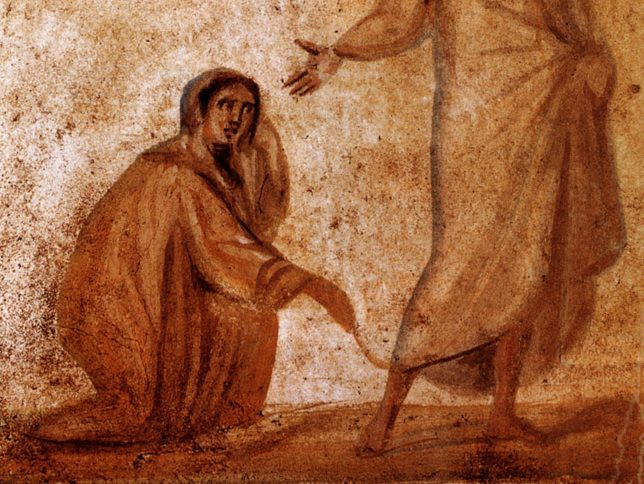
From there, Jesus starts touching unclean people: first a woman who has been bleeding for over a decade, then a dead body. For a faithful Jew, these things would have made you unfit to participate in the life of the community until you had become ritually clean again. The woman herself, because of her condition, would have been considered unclean, and so in all likelihood she has been someone most people aren’t associating with for that whole time. In all of these interactions—Matthew, the unnamed woman, the daughter of Jairus—Jesus is being very intentional in going beyond the boundaries of what would be expected from a good Jewish man.
This is one of the many, many times in the gospels where Jesus interacts with people and does things that make perhaps even us say, “Jesus, what are you doing?” And this is paradigmatic for the ways that we interact with Jesus today. Jesus is always going out beyond what we expect. Jesus is always showing up in people, in situations where we are not looking for him. He has always been this way, and today we are given a very good reminder of that. These interactions that Jesus has and the ways that the people around him respond make me stop and ask where I have encountered that in my life. Where have I had this reaction to Jesus?
A couple of years ago, I was at a clergy conference where we heard from a man named Daryl Davis, who made his career as an R&B pianist, touring with some of the greats like Chuck Berry and Jerry Lee Lewis. But the thing that perhaps he is actually most famous for is that, as a Black man, since the ’80s, he has been befriending members of the Ku Klux Klan. His goal is to build relationships with people who really want nothing to do with him and who most of us would expect that he wants nothing to do with, to help them see that he is a person. In the interviews and articles you can find, it’s incredible to hear the ways that he leans into the unlikelihood of the friendship being its own justification. In many cases, the friendships that he has built with these virulently racist people, who most of us would want nothing to do with, has led to many renouncing their beliefs and hanging up their hoods. “You can’t beat the meanness out of a mean dog,” he says. “You can’t hate someone out of hating. But you can love them out of it.” I remember sitting there and feeling my heart harden. Surely this isn’t really how we make peace. Surely we shouldn’t be expecting this man, of all people, to be doing this. And yet there he was, doing it. By crossing the line and sitting down with them, with no agenda other than friendship, Davis has brought people back to life from places that I think most of us would be happy to leave them in. They credit him, in their own words, with saving their lives.
I’m also thinking of a woman I met many years ago when I was living in Philadelphia. There was this bar called Bob and Barbara’s, known for live jazz many nights of the week. But what really kept me coming back was the Thursday night cabaret hosted by Miss Lisa-Lisa, a very large personality, somebody who you cannot ignore and she wouldn’t want you to. There’s one night I remember in particular, as Miss Lisa performed “My Way” by Frank Sinatra, which is of course a loud and proud song about perseverance and overcoming the many challenges that life throws at you. I’ve heard this song plenty of times, but that night, there was something about the tone in her voice and the strength in her spine and the look in her eye that, showed me something beyond words about this woman who had been through it, who had found something that gave her the strength and the healing to carry on, and she was here to make sure you knew about it. And even though she didn’t mention God, Miss Lisa took me to church that night in that dark little bar on South Street, on a tiny platform next to a Hammond B-3 organ. I’m not sure what made that night different from the others. It might be the only specific memory I have from any of the nights I spent at Bob and Barbara’s, but something about that night and that performance imprinted itself on my memory. I realized later that part of what gave that moment its authority was because Miss Lisa knew where she had been as a transgender woman and came through the other side of all the challenges and obstacles put in her way. Much like the woman who had the audacity to reach out and touch Jesus’s robe, Miss Lisa knew what it was like when someone has the audacity to stop and listen to the story of a woman who has been told to stay out of the way and simply suffer. Jesus could have ignored her or condemned her audacity or confirmed the prejudices of those around him. Instead he tells her to go in peace and claim the wholeness that God had given her and had always intended for her. I know that saying that to most American Christians would be very challenging. Most American Christians would not be able to recognize the work of the Spirit of life, of the spirit of God in trans people. But people like Miss Lisa and Daryl Davis and the many trans people I know are all people who today make those around them go, “What are you doing? What do you mean you’re gonna go over there, do that thing, talk to those people, and squeeze some new life out of it?”
That is what Jesus is doing in these readings. Jesus is hanging out with people across the barriers that we set up. We serve a God that doesn’t need binaries. We serve a God who is, in the words of Paul, breaking down the dividing wall, reconciling all people to one another. In these stories, Jesus reminds us that no one is beyond redemption. No one is beyond the new life that Jesus is bringing into the world. No one, not even those who are dead, not even those we have given up for dead, are beyond what God is doing. And that is the best news of all.
There are people in our lives who, whether we would like to or not, we have written off. We believe that there is nothing that can be done for the situation. There is nothing good that can come out of that person or that relationship. There may even be parts of our very own selves that we have written off. Nothing is beyond new life. Nothing is beyond redemption. Not even you. We need to remain open to that.
When we come to this altar and receive the bread and the wine that is the body and blood of Jesus, we are committing ourselves to being like Jesus and asking for help to go where he goes, beyond the barriers, beyond the binaries, to find the places that need new life and to offer that life in his name. Let us remember who Jesus is. Let us remember that feeling of where are you going, and then not let that feeling hold us still in fear, but then follow him and go where he leads, so that when he says, “Follow me,” we, like Matthew, can do nothing else but get up and go.


Leave a Reply